• Skip to primary navigation
  • Skip to main content
  • Skip to primary sidebar
  • Skip to footer

IPMojo

  • About IP Mojo
  • About Scott Coulthart
  • CONTACT
BOOK AN APPOINTMENT

Archives for September 2025

September 19, 2025 by Scott Coulthart

Whose Footage Is It Anyway? Game Meats v Farm Transparency Heads for the High Court
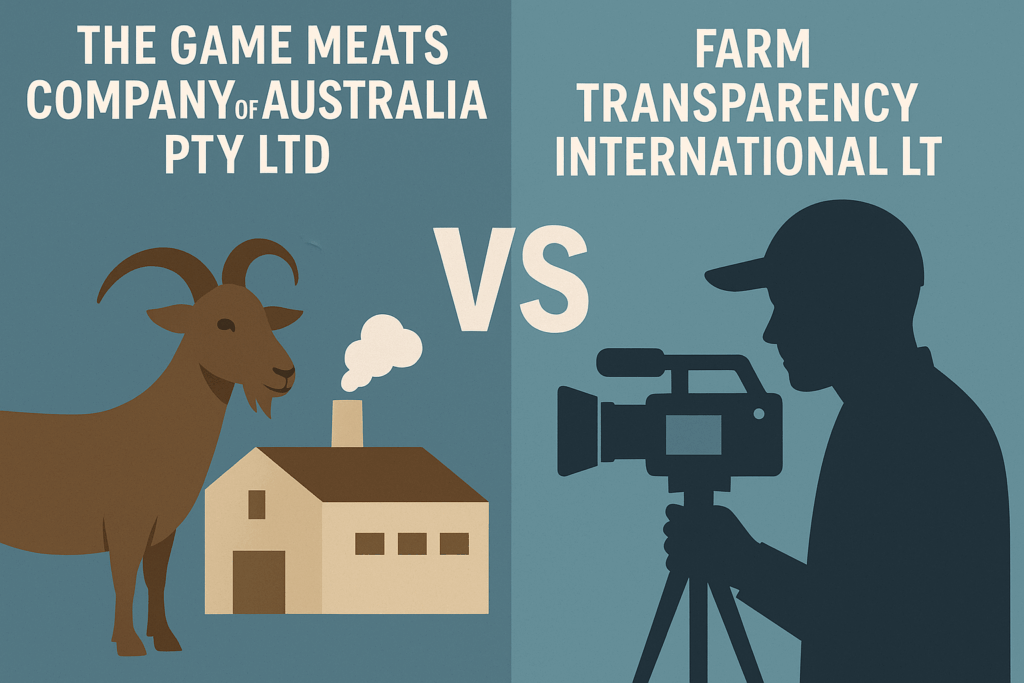
When animal rights collide with copyright law, sparks fly — and sometimes, whole new branches of doctrine get tested.

That’s exactly what’s happening in The Game Meats Company of Australia Pty Ltd v Farm Transparency International Ltd, a dispute that has already produced one significant Federal Court decision, a reversal on appeal, and now an application for special leave to the High Court.

Let’s unpack how a covert camera operation at a Victorian abattoir has turned into one of the most intriguing copyright–equity battles in years.

The Backstory: Covert Cameras at Eurobin

Game Meats Company (GMC) operates a halal abattoir in Eurobin, Victoria. Early in 2024, members of Farm Transparency International (FTI), an animal advocacy organisation, repeatedly trespassed onto the site. They crawled under fences at night, installed hidden cameras, and over several months captured more than 100 hours of footage of the abattoir floor.

From that material, FTI produced a 14-minute video highlighting what it claimed were instances of animal cruelty. The video was sent to government regulators, passed to Channel Seven (which reported but did not broadcast the footage), and later published by FTI online alongside a media release.

GMC responded immediately with proceedings in the Federal Court.

Round One: Damages but No Injunction

At trial, Justice Snaden held that FTI had committed trespass and was liable for damages — awarding GMC $30,000 in general damages and $100,000 in exemplary damages.

However, the judge refused GMC’s bid for a permanent injunction to restrain publication, and also rejected the argument that copyright in the footage should be held on constructive trust for GMC.

Why? The Court accepted that damages could compensate GMC for its losses, and held that the extraordinary remedy of imposing a trust over copyright was not justified. FTI remained the legal owner of the copyright — even though it was created through trespass.

Round Two: The Full Federal Court Steps In

GMC appealed, and in August 2025 the Full Federal Court (Burley, Jackman and Horan JJ) reversed key parts of the primary decision.

The Court:

  • Declared a constructive trust: copyright in the footage was to be held on trust for GMC.

  • Ordered assignment: FTI had to execute a written assignment of copyright, with the Registrar empowered to do so if FTI refused.

  • Granted a permanent injunction: restraining FTI from publishing the material, other than to regulators.

  • Ordered deletion: FTI was required to permanently delete its copies of the footage and swear affidavits confirming destruction.

In doing so, the Full Court leaned heavily on dicta from ABC v Lenah Game Meats (2001) 208 CLR 199, where the High Court floated — but did not apply — the idea that copyright created through unlawful conduct might be held on constructive trust.

Two decades later, that possibility became a reality.

The Key Legal Issue: Equity Meets Copyright

At the heart of this case is whether copyright — a statutory right conferred automatically on the maker of a film — can be stripped away by equity when the film was created through trespass or other unlawful means.

  • Statutory law: Under the Copyright Act 1968 (Cth), FTI owned copyright in the footage the moment the cameras recorded it.

  • Equity: The Full Court held it was “inequitable and against good conscience” for FTI to assert ownership against GMC, given the trespass. Equity could therefore declare FTI a constructive trustee and compel assignment.

It’s a bold move. Courts have long imposed constructive trusts over physical property obtained unconscionably. Applying the same logic to intangible IP rights is legally elegant — and potentially disruptive.

What’s at Stake in the High Court?

FTI has now applied for special leave to appeal to the High Court. No hearing date is set yet, but the case is primed for the nation’s top court.

The issues are weighty:

  • Limits of equity: Can equity truly override the statutory scheme of copyright ownership?

  • Freedom of communication: Does restraining publication of the footage unduly burden the implied freedom of political communication, given FTI’s advocacy role?

  • Activism vs. property rights: Should activists lose IP rights in their material because of unlawful methods, or does that chill legitimate public interest advocacy?

Why It Matters

For copyright lawyers, this case is a doctrinal turning point. For animal rights advocates and agribusiness, it’s a test of how far covert activism can go before the law snaps back.

If the Full Court’s reasoning stands, companies may be able to use IP and equity as powerful tools against activists: not only recovering damages for trespass, but also stripping activists of copyright and controlling the very footage they created.

If the High Court takes a different path, we may instead see limits on equity’s reach, preserving copyright ownership even where the work was created unlawfully — with important implications for journalism, whistleblowing, and advocacy.

IP Mojo Takeaway

This case is far more than a goat-abattoir dispute. It’s about whether copyright is truly absolute, or whether conscience can trump statute. With special leave now sought, the High Court will soon have the chance to answer.

Watch this space — the ghost of Lenah Game Meats is back in Canberra.
Filed Under: Copyright, Film Law, IP, Remedies Tagged With: Copyright, Film Law, IP, Remedies

September 18, 2025 by Scott Coulthart

Watson Webb v Comino: When Valves Burst Into a Multi-IP Flood

If you thought plumbing valves were boring, think again.

The Federal Court’s recent decision in Watson Webb Pty Ltd v Comino [2025] FCA 871 is a sprawling reminder that IP disputes can leak into every corner of the law — from designs and copyright to confidence, consumer law and patents.

The Case in a Nutshell

At the heart of the fight was who really owned the rights to a series of valve designs — All Valve Industries (AVI) and its Italian partner Cimberio, or Mr Comino and his company Strongcast. What started as a commercial relationship around importing and distributing valves became a flood of litigation once design drawings, product launches and patent filings entered the picture.

Designs: Entitlement, Validity and Infringement

  • Entitlement: The Court found that Cimberio was at least a co-designer of the registered designs. Mr Comino couldn’t claim sole credit.

  • Validity: The designs were new and distinctive enough over prior art.

  • Infringement: AVI’s products weren’t substantially similar, so no design infringement was made out.

  • Unjustified threats: A strongly worded solicitor’s letter wasn’t enough to count as a threat.

Copyright: Drawings Matter

The critical twist: design registration was based on drawings created by Cimberio. Using them without permission crossed into copyright infringement.

The Court found:

  • Cimberio’s copyright subsisted in the drawings.

  • Comino and Strongcast copied and authorised copying when they used those drawings to file design applications.

  • Cimberio is entitled to an account of profits plus additional damages.

Breach of Confidence and Constructive Trust

The same drawings carried obligations of confidence. Comino’s disclosure and use of them breached that duty.

The Court imposed a constructive trust — transferring Comino’s interest in the registered designs to Cimberio.

That’s a dramatic remedy, showing courts will reorder ownership when confidential information is misused.

Consumer Law: Silence Speaks

By not telling AVI and Cimberio that the drawings were being used to file design rights, Comino engaged in misleading conduct under s 18 ACL.

Silence can mislead — especially in a close commercial relationship.

Patents: Invalid and Ineffective

Strongcast also relied on an innovation patent for a pipe bracket.

The Court held claims 1–4 invalid for lack of clarity, support, sufficiency and novelty.

Even if valid, no infringement was established.

Why It Matters

This case is a reminder that:

  • Design entitlement must be nailed down early — who really created the design?

  • Copyright overlaps with designs are still powerful, especially when drawings are copied into applications.

  • Constructive trusts are on the table where confidential information is misused.

  • Consumer law can bite in IP disputes in many and varied ways — misleading silence can be enough.

  • Innovation patents (now extinct) often struggled on validity grounds.

What looks like a simple plumbing part turned into a judgment that touches almost every corner of IP law.

For brand owners, designers and manufacturers, the message is clear: guard your drawings, document your entitlement, and don’t assume silence will save you.

Filed Under: Confidentiality, Copyright, Designs, IP, Patents Tagged With: Confidentiality, Copyright, Designs, IP, Patents

September 17, 2025 by Scott Coulthart

Aristocrat’s Jackpot: Full Court Revives Gaming Machine Patents

When does a slot machine cross the line from an abstract idea to a patentable invention?
After years of litigation, remittals, and even a 3–3 deadlock in the High Court, the Full Federal Court has finally tipped the balance in Aristocrat’s favour.

🎰 The Long Spin

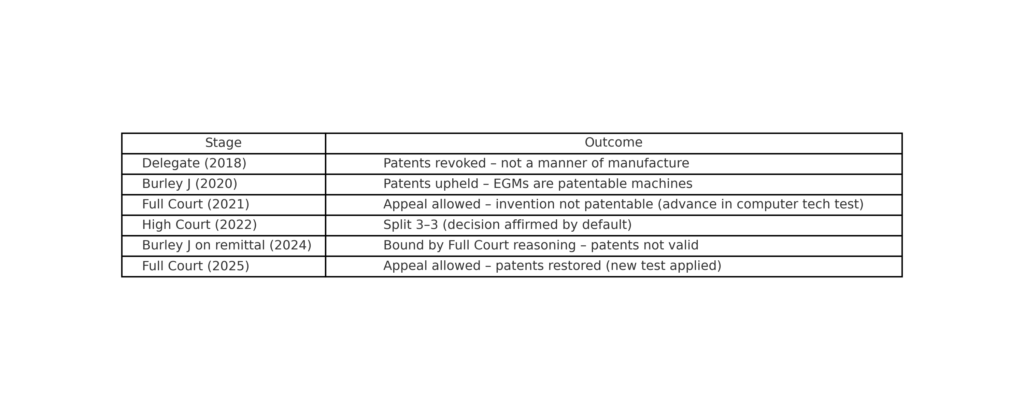
Aristocrat has been fighting since 2018 to keep its patents over electronic gaming machines (EGMs) with “configurable symbols” — feature games that change play dynamics and prize allocation. The Commissioner argued these were just abstract rules of a game dressed up in software. Aristocrat said they were genuine machines of a particular construction that yielded a new and useful result.

The case bounced through:

  • Delegate (2018): patents revoked.

  • Burley J (2020): Aristocrat wins.

  • Full Court (2021): Aristocrat loses (majority invents “advance in computer technology” test).

  • High Court (2022): split 3–3, affirming the Full Court’s result by default under Judiciary Act s 23(2)(a).

  • Remittal (2024): Burley J reluctantly applies Full Court reasoning against Aristocrat.

Cue the latest appeal.

⚖️ The Precedent Puzzle

The Full Court (Beach, Rofe & Jackman JJ) confronted a thorny problem: should it stick to its own 2021 reasoning when the High Court had unanimously rejected that reasoning, even though no majority emerged?

The answer: No.

  • Only majority or unanimous High Court views are binding.

  • But the High Court’s unanimous criticism provided a “compelling reason” to abandon the earlier Full Court approach.

  • The Court found “constructive error” — not blaming Burley J, but recognising the law had to move on.

🖥️ Rethinking “Manner of Manufacture”

The Court reframed the test for computer-implemented inventions:

  • Not patentable: an abstract idea manipulated on a computer.

  • Patentable: an abstract idea implemented on a computer in a way that creates an artificial state of affairs and useful result.

Applying this, Aristocrat’s claim 1 was patentable — and by extension, so were the dependent claims across its four patents. The EGMs weren’t just abstract gaming rules. They were machines, purpose-built to operate in a particular way.

💡 Why It Matters

  • For patentees: This revives hope for computer-implemented inventions beyond “pure software” where technical implementation creates a new device or process.

  • For examiners: IP Australia may need to recalibrate examination practice on software-related patents — the “advance in computer technology” yardstick is gone.

  • For practitioners: This is a case study in how precedent, process, and patents collide. The High Court’s split didn’t end the story — it forced the Full Court to resolve it.

🚀 Takeaway

The Full Court has effectively reset the slot reels. Aristocrat’s EGMs are back in play, and the scope of patentable computer-implemented inventions in Australia looks a little brighter.

Sometimes the house doesn’t win.

Filed Under: Digital Law, Gaming Law, IP, Patents, Technology Tagged With: Digital Law, Gaming Law, IP, Patents, Technology

September 16, 2025 by Scott Coulthart

Epic Won the Battle. Now Developers Want Their Refunds.

When Epic Games went head-to-head with Apple, the Federal Court found that Apple misused its market power by locking iOS developers into the App Store and its payment system. That was big. But the Anthony v Apple class action takes it a step further: what if Apple has been overcharging Australian developers and consumers for years?

From liability to dollars

In Epic v Apple [2025] FCA 900, Justice Beach held that Apple’s restrictions substantially lessened competition in two markets:

  1. iOS app distribution; and

  2. iOS in-app payment solutions.

That case was about liability — whether Apple broke the law.

In Anthony v Apple Inc [2025] FCA 902, the Court applied those findings in the context of a class action by developers and users. This time, the question wasn’t just “did Apple misuse its power?” but “what should Apple have charged if competition had been allowed?”

The counterfactual commission

Apple famously takes up to 30% of in-app revenue. The class action alleges that this cut was inflated by Apple’s anti-competitive restrictions.

Justice Beach accepted that the key issue was whether commissions exceeded the “counterfactual” level — i.e. the rate that would have prevailed in a competitive market.

That’s not just a legal puzzle. It’s an economic modelling exercise: estimating what rival app stores and payment processors would have charged, and how Apple’s fees distorted prices across the app ecosystem.

Why this matters

  • Developers: If successful, they may recover damages for inflated commissions they’ve paid over years. That could mean real money back into the hands of Australian app makers.

  • Consumers: If commissions were inflated, those costs were often passed on through higher app and in-app purchase prices. Compensation claims could extend to end users.

  • Apple (and Google): The damages bill could be eye-watering. Liability findings are one thing; being ordered to pay back billions is another.

A coordinated strategy

Justice Beach emphasised that his reasons in Anthony v Apple should be read together with Epic v Apple and Epic v Google. This isn’t three random cases — it’s a coordinated litigation front against the app store model.

First, establish liability (Epic).
Then, pursue compensation (Anthony).
Finally, broaden the net (Epic v Google).

The bigger picture

Globally, regulators and courts are converging on the same theme: Apple and Google can’t use security or convenience as a shield for overcharging.

Australia’s twist? Class actions have a way of turning abstract competition law into concrete refunds.

⚖️ The takeaway

Epic v Apple broke open the wall. Anthony v Apple asks whether Apple should hand back the gold it’s been collecting inside.

This isn’t just another round in the same fight — it’s the damages phase of the app store wars. And it could hit closer to home for Australian developers and users than anything Epic ever fought for.

Filed Under: Competition Law, Digital Law, Remedies, Technology Tagged With: Competition Law, Digital Law, Remedies, Technology

September 15, 2025 by Scott Coulthart

Copy That, Part 10 – Copyright Myths Busted: Top Misunderstandings

The most dangerous thing about copyright? What people think they know.

Myths abound, and they can land creators and businesses in hot water. Let’s bust a few of the biggest.

Myth 1: “If it’s on the internet, it’s free to use.”

Nope. Online doesn’t mean ownerless. Copyright applies the moment a work is created and uploaded.

Myth 2: “I gave credit, so I can use it.”

Attribution is important, but it’s not a substitute for permission. Unless a licence or exception applies, copying is still infringement.

Myth 3: “I changed it, so it’s mine.”

Derivative works—like remixes, adaptations, and mash-ups—still require permission from the original copyright owner.

Myth 4: “It’s educational, so it’s fine.”

Education has some specific statutory licences and exceptions, but they’re limited and tightly regulated. “I used it in class” doesn’t automatically mean fair dealing.

Myth 5: “I bought it, so I own the copyright.”

Buying a book, CD, or digital download gives you the copy—not the underlying rights. Only the copyright owner controls reproduction, adaptation, and distribution.

Myth 6: “The 10% rule – if I change 10%, I’m safe.”

There’s no such thing. Courts look at whether a substantial part of the original work has been copied, not a percentage. Even a small portion can infringe if it captures the essence of the work.

Myth 7: “I added a little to the program, so now we both own it.”

Not true. Adding a minor change or tweak to software (or any work) doesn’t automatically give you joint ownership. You might own the copyright in your new contribution, but the original creator still owns their part—and you can’t exploit the combined work without permission.

IP Mojo tip: get advice, not assumptions

Relying on myths is a shortcut to infringement. When in doubt, check the licence terms, rely on fair dealing only where it clearly applies, or get legal advice.

Series Wrap-Up: Copy That

Over 10 instalments, we’ve explored the world of copyright in Australia—what it protects, who owns it, how long it lasts, when you can use someone else’s work, and how to share and enforce your own. Along the way, we’ve debunked myths, unpacked rights, and hopefully shown that copyright isn’t just a legal technicality—it’s a practical toolkit for protecting creativity and powering business.

If there’s one takeaway, it’s this: don’t rely on assumptions. Copyright law is full of nuance. A quick check, a clear agreement, or a simple licence can save years of disputes.

👉 That’s a wrap for Copy That: The IP Mojo Guide to Copyright in Australia.

But IP Mojo isn’t stopping here. Stay tuned for our next series, where we’ll dive into another corner of intellectual property and digital law—because your ideas, brands, and content deserve more than protection. They deserve strategy.

Follow along at IP Mojo for what’s next.

Filed Under: Copyright, Copyright Series, IP Tagged With: Copyright, Copyright Series Part 10, IP

September 12, 2025 by Scott Coulthart

Epic Down Under: How Australia Took a Bite Out of Apple’s Walled Garden

When Epic Games took on Apple in the US and Europe, the headlines practically wrote themselves – it was billed as a David-and-Goliath showdown between the Fortnite maker and the Cupertino colossus. Now, the same fight has reached Australian shores — and the Federal Court has bitten into Apple’s walled garden.

When Epic Games v Apple erupted in the US in 2020, Fortnite, the global gaming juggernaut, had been punted from the App Store after Epic tried to sneak in its own cheaper payment system. Cue a legal battle royale over whether Apple’s “walled garden” was innovation, exploitation, or both.

Fast forward to August 2025, and the fight has gone local. In Epic Games, Inc v Apple Inc [2025] FCA 900, Justice Beach of the Federal Court handed down a sprawling 6,347-paragraph judgment — and while not everything went Epic’s way, the headline is clear: Apple misused its market power under s 46 of the Competition and Consumer Act 2010 (Cth).

Australia has officially joined the global chorus questioning how far Big Tech’s gatekeeping power can go.

The legal frame: two markets, one gatekeeper

Epic’s case hinged on market definition — the first battlefield of any competition law fight. Epic said there were two relevant markets:

  1. The iOS app distribution market – how apps get onto iPhones and iPads.

  2. The iOS in-app payment solutions market – how digital content is paid for inside apps.

Apple argued for something broader: a market for “app transactions”, with plenty of alternatives. Justice Beach wasn’t buying it. He sided with Epic’s narrower framing, recognising that Apple was the sole gatekeeper in both distribution and in-app digital payments.

From there, the logic snowballed: Apple’s rules preventing sideloading (direct downloads) and banning alternative payment systems substantially lessened competition. That, in turn, triggered contraventions of s 46 (misuse of market power) and s 47 (exclusive dealing).

Epic didn’t get everything it wanted — some claims under s 21 of the ACL (unconscionable conduct) fell flat, and Apple’s ban on rival app stores inside the App Store was upheld. But the central wins are seismic.

Apple’s defence: “But security!”

Apple leaned heavily on security as a justification. Its argument: a centralised, curated App Store keeps users safe from malware, fraud, and scams.

Justice Beach accepted there were genuine security benefits — Apple’s model really does provide higher baseline quality and safety compared to the Wild West of sideloaded apps.

However, crucially, he ruled that security doesn’t trump competition law. A legitimate purpose (protecting users) doesn’t erase the anti-competitive effects (locking out rivals) – or as the Court put it: “The existence of a security purpose says little about the effect or likely effect of Apple’s restrictive conduct in terms of competition questions.”

What this means for…

Developers

Epic signalled it would jump into iOS distribution if given the chance.

Others will follow. Think Spotify, payment processors like Stripe, or even local players offering niche app stores.

The judgment cracks open a door that’s been locked since 2008.

Consumers

If remedies flow, users could see lower prices and more choice.

Developers paying Apple’s 30% cut have long argued they’re forced to inflate in-app purchase prices.

Alternatives could push those costs down — though don’t expect Apple to give up without a fight.

Regulators

The decision aligns with the ACCC’s Digital Platform Services Inquiry, which has repeatedly flagged Apple’s and Google’s control over app ecosystems.

Australia may now move closer to Europe’s Digital Markets Act, which mandates interoperability and alternative app stores.

Apple

Even if remedies are still pending, the finding of liability alone is a reputational hit.

Apple’s “we know best” stance has always traded on consumer trust. Now it must reckon with courts telling it that choice matters too.

The global context

This ruling doesn’t exist in a vacuum. It follows:

  • The US: where Epic’s case against Apple produced a mixed bag — Apple largely won at trial, but Epic clawed back some ground on appeal.

  • The EU: where the Digital Markets Act forced Apple to allow rival app stores and alternative payment methods in early 2024.

  • South Korea and Japan: already experimenting with app store regulation.

Australia is now firmly in the mix. What started as a Fortnite scuffle is becoming a global test of whether digital gatekeepers can keep locking the gates.

Where to next?

Justice Beach has reserved questions of relief for another hearing.

That means the really juicy part — what remedies Apple will face in Australia — is still to come. Options range from structural orders (sideloading must be allowed) to behavioural remedies (Apple must permit rival payment providers).

Whatever the outcome, one thing is clear: the walled garden isn’t as impregnable as Apple thought – and Epic may have just turned its legal battle royale into a global trend of regulatory respawn.

⚖️ The takeaway

For digital lawyers, regulators, and anyone building on someone else’s platform: this case is a reminder that market power is never just a tech problem — it’s a legal one.

When innovation, competition, and consumer choice collide, courts are willing to get out the pickaxe.

Filed Under: Competition Law, Digital Law, Technology Tagged With: Competition Law, Digital Law, Technology

  • « Go to Previous Page
  • Go to page 1
  • Go to page 2
  • Go to page 3
  • Go to page 4
  • Go to Next Page »

Primary Sidebar

Recent Posts

  • 🏇 When the Race Stops a Nation — Who Owns the Moment?
  • AI Training in Australia: Why a Mandatory Licence Could Be the Practical Middle Ground
  • AI-Generated Works & Australian Copyright — What IP Owners Need to Know
  • When Cheaper Medicines Meet Patent Law: Regeneron v Sandoz
  • #NotThatFamous: When Influencer Buzz Fails the s 60 Test

Archives

  • November 2025 (1)
  • October 2025 (14)
  • September 2025 (21)
  • August 2025 (18)
  • July 2025 (16)
  • June 2025 (21)
  • May 2025 (12)
  • April 2025 (4)

Footer

© Scott Coulthart 2025