• Skip to primary navigation
  • Skip to main content
  • Skip to primary sidebar
  • Skip to footer

IPMojo

  • About IP Mojo
  • About Scott Coulthart
  • CONTACT
BOOK AN APPOINTMENT

Archives for September 2025

September 3, 2025 by Scott Coulthart

Copy That, Part 7: Licensing and Assignment: How to Use and Share Copyright
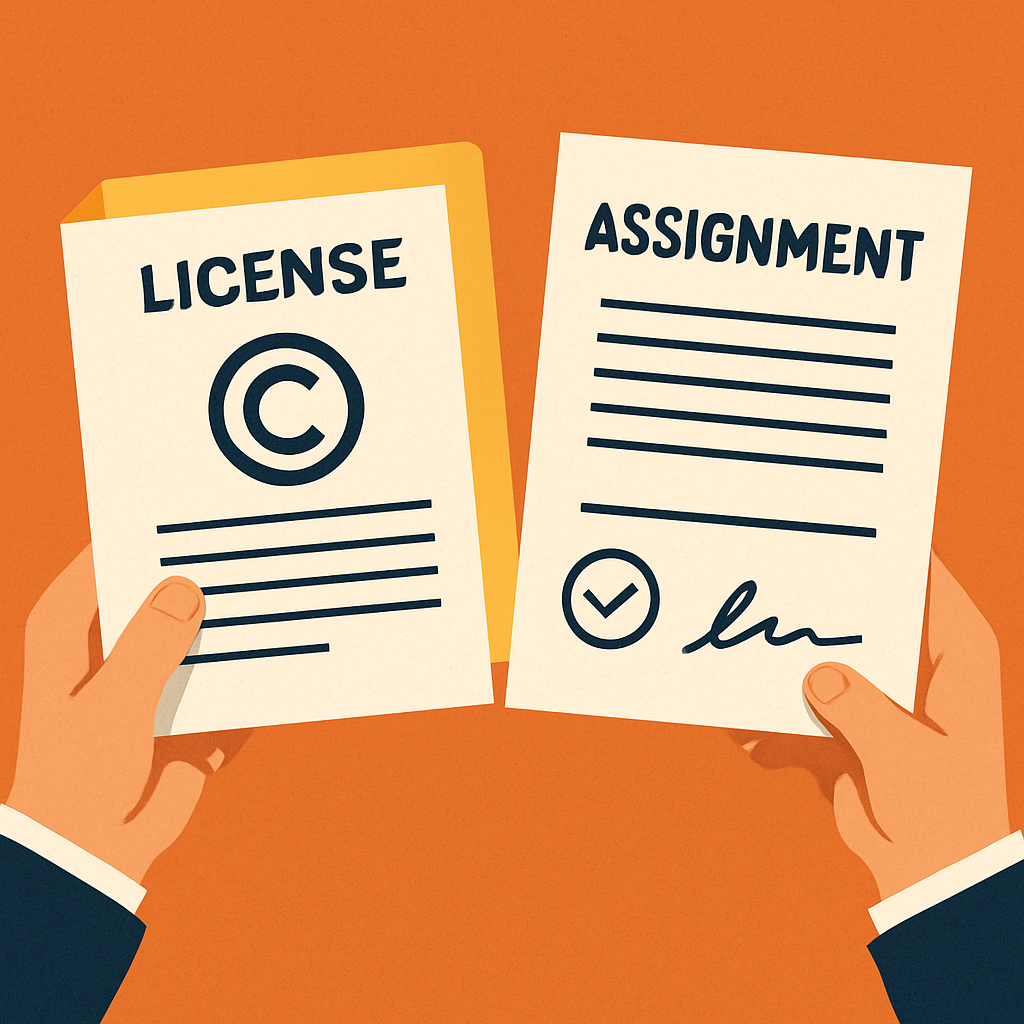
Owning copyright doesn’t mean you have to keep it locked away. In fact, some of the most powerful uses of copyright come from sharing it—on your terms. That’s where licensing and assignment come in.

Licensing: permission with strings attached

A licence is essentially permission for someone else to use your work in a certain way. You remain the owner, but you set the rules.

Licences can be:

  • Exclusive – only the licensee can use the work in that way (even you, the owner, may be excluded). Exclusive licences should always be in writing.

  • Non-exclusive – you can license the same rights to multiple people at the same time.

  • Implied – sometimes the circumstances imply a licence (e.g. sending your customer a graphical design they asked you to make for their business cards implies they can have it copied on to their business cards). But relying on implication is risky—always better to spell it out.

Creative industries often use open licences like Creative Commons to allow broad, standardised sharing. These licences can be very flexible, but once granted, they can’t easily be revoked.


Sidebar: Creative Commons vs Copyleft

These two often get confused, but they’re not the same thing.

  • Creative Commons (CC):
    A suite of standard licences that creators can choose from. Some are very open (like CC0, which waives rights), while others are more restrictive (like CC BY-NC, which bars commercial use).

  • Copyleft:
    A philosophy that says: you can use, modify, and share this work freely, but if you create something new from it, you must share that new work under the same terms.

  • Where they overlap:
    Some Creative Commons licences, like CC BY-SA, include a “ShareAlike” condition. That’s essentially a form of copyleft—any derivatives must be licensed the same way. But not all Creative Commons licences have this feature.

👉 In short: Creative Commons is a toolkit of licences. Copyleft is a principle. Some CC licences apply copyleft; others don’t.


Assignment: a permanent transfer

An assignment is different: it transfers ownership itself.

  • Assignments must be in writing and signed by the current owner.

  • They can cover all rights, or just some (e.g. assigning film rights but keeping publishing rights).

  • Once assigned, the new owner steps into your shoes and can enforce copyright as if they were the creator.

Assignments are common in publishing contracts, music catalogues, software acquisitions, and business sales.

Why the distinction matters

  • A licence gives someone permission; you still own the copyright.

  • An assignment gives someone ownership; you no longer do.

Mixing the two up in a contract can cause years of confusion—or even litigation.

IP Mojo tip: share smart, not loose

When letting others use your work, always be clear:

  • Who is allowed to use it

  • What they can do with it

  • Where and for how long they can use it

  • Whether the permission is exclusive or not

  • How much (if anything) they’ll pay for it

That clarity is what turns copyright from a legal safety net into a practical business tool.


Next up in our Copy That series:
Part 8 – Infringement and Enforcement: What Happens When It Goes Wrong
Because copyright only matters if you can enforce it when lines are crossed.
Filed Under: Copyright, Copyright Series, IP Tagged With: Copyright, Copyright Series Part 7, IP

September 2, 2025 by Scott Coulthart

What happens when your new brand smells a little too much like the towels next door? (High Court Edition)

The linen wars have gone all the way to the top.

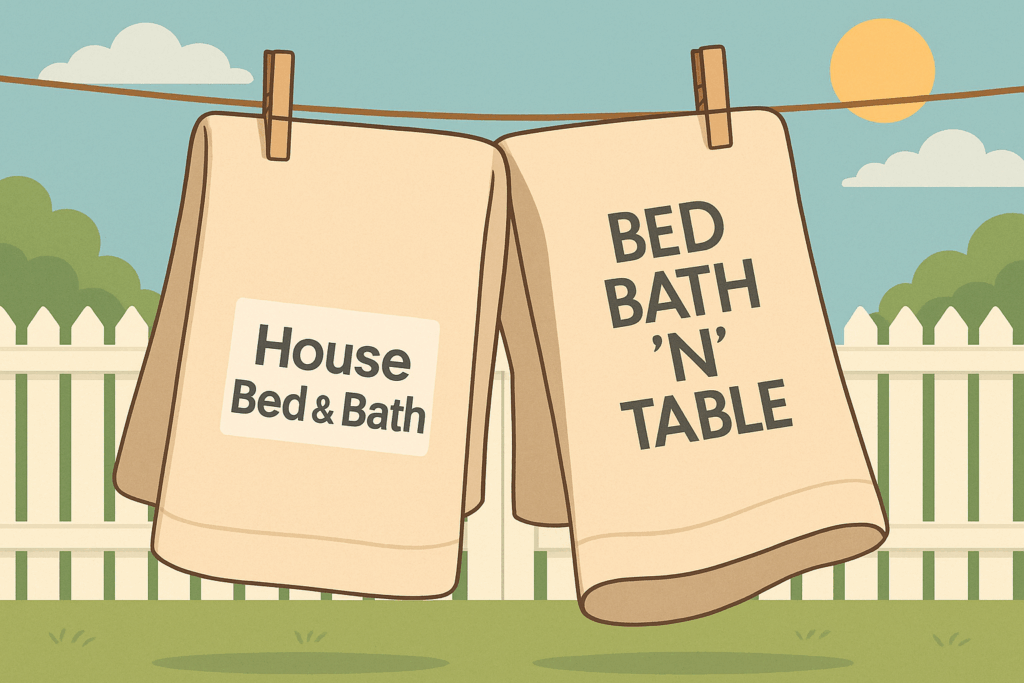
Earlier this year, we wrote about Global Retail Brands Australia (GRBA) — the team behind House and its spin-off House Bed & Bath — squaring off against soft-homewares stalwart Bed Bath ‘N’ Table (BBNT). The Federal Court split the baby: no trade mark infringement (the marks weren’t deceptively similar), but misleading conduct and passing off were found at first instance. The Full Federal Court overturned those latter findings, giving GRBA a win.

Now, the High Court has heard the appeal, reserved its decision, and the case is poised to reshape the way Australian law balances trade mark rights, reputation, and consumer protection.


The clash of frameworks: trade mark vs consumer law

At the heart of the battle is the distinction sharpened by the High Court in Self Care v Allergan (2023).

  • Trade mark infringement under the Trade Marks Act 1995 (Cth) is an artificial “mark-on-mark” comparison, stripped of reputation, history, and context.

  • Misleading and deceptive conduct under the ACL (and passing off) is broader, taking in the real-world reputation of the trader, the marketplace, and consumer impressions.

BBNT argues the Full Federal Court collapsed the distinction by effectively treating the failure on the trade mark claim as the “starting point” for rejecting the ACL/passing off claims. In its view, that’s a methodological error: reputation and consumer context should drive the ACL analysis.

GRBA counters that there were “substantial and crucial differences” between House Bed & Bath and Bed Bath ‘N’ Table, and — critically — that BBNT had no independent reputation in Bed & Bath alone. Any risk of confusion, they say, was theoretical at best.


Inside the High Court hearing

The transcript gives a flavour of the tension. Counsel for BBNT pressed that the proper inquiry under the ACL was not whether the marks looked deceptively similar in the abstract, but what meaning a reasonable consumer would take in light of BBNT’s 40 years of unique use of Bed Bath ‘N’ Table in the soft-homewares market. Add GRBA’s adoption of a Hamptons-style fit-out, similar typography, and the deliberate choice of “Bed & Bath” over alternatives like House Bath & Bed or House Bedworks, and the picture (they say) becomes clear.

GRBA, in response, stressed that “House” dominates their brand and that consumers couldn’t miss it “save through exceptional carelessness or stupidity” (yes, that’s the phrase from the Full Court). They emphasised that BBNT’s reputation rested in the whole composite mark — Bed Bath ‘N’ Table — not the sliced-off “Bed & Bath” segment.


The bigger questions

The case raises issues far beyond duvets and towels:

  1. Can reputation in a composite mark give effective monopoly over common category words? BBNT says yes, at least where decades of unique use have entrenched association. GRBA says no — descriptive words like “bed” and “bath” can’t be locked up, even after 40 years.

  2. Does “wilful blindness” matter? The primary judge thought GRBA’s conduct (and evidence of strategic borrowing) was “fitted for the purpose” of diverting trade. The Full Court disagreed, saying sharp elbows in commerce don’t necessarily equal deception.

  3. Where do trade mark law and the ACL intersect? The High Court is being asked to clarify whether a finding of no trade mark infringement makes it harder — or irrelevant — to succeed under consumer law.


Why it matters

For retailers and brand advisors, this case could reset the boundaries between:

  • Protectable brand equity and the freedom to use descriptive terms;

  • Strategic mimicry and unlawful deception;

  • The narrow lens of statutory trade mark rights and the broader sweep of consumer expectations.

If the High Court restores the primary judge’s finding for BBNT, it could embolden established brands to take action even where marks aren’t deceptively similar, so long as the marketplace context points to deception. If it affirms the Full Court, it will signal that descriptive terms are fair game, and that reputation in a composite mark doesn’t easily fracture into enforceable monopolies over its parts.


Final thoughts

The towels are still fluffed, the pillows puffed, and the decision is pending.

Whichever way the High Court turns, this case will be cited in branding disputes for years. It’s a live stress test of how Australia draws the line between brand mimicry and market misconduct.

And for those keeping track of timing, yes — the Court has reserved. Whether judgment arrives by Towel Day next year remains to be seen.


👉 We’ll update when the High Court finally beds down its answer. Until then, trade mark lawyers and brand managers should keep one eye on Doncaster and Chadstone… and the other on the High Court bench.

Filed Under: Consumer Law, IP, Trade Marks Tagged With: Consumer Law, IP, Trade Marks

September 1, 2025 by Scott Coulthart

Copy That, Part 6 – Copyright and the Digital Age: Online Use, Streaming, and AI

If it’s online, it’s free to use… right? Wrong.

Copyright applies just as much to digital works as it does to a printed novel or a painting hanging in a gallery. The internet hasn’t erased the rules—it’s just made them easier to break (and harder to track).

Online sharing is still “publication”

Uploading a work—whether to YouTube, Instagram, or your company’s website—is a “communication to the public” under the Copyright Act. That means:

  • If it’s your work, you control whether and how it’s shared.

  • If it’s someone else’s, you need their permission unless an exception applies.

Tip: Even sharing a photo on your social media page can be infringement if you don’t have rights to it.

Embedding and linking: a grey zone

In Australia, simply linking to material usually isn’t infringement—unless you link to content you know (or should know) is infringing.

However, embedding (e.g. showing a YouTube video directly on your site) can raise trickier questions, especially if the embedded content bypasses restrictions or was uploaded without authorisation.

User-generated content and platforms

Social media and content-sharing platforms rely on a mix of:

  • User agreements (you often grant them a licence to your uploads)

  • “Safe harbour” provisions (protecting platforms if they remove infringing content when notified)

But these protections don’t extend to users—you’re still liable for what you upload.

Streaming and digital downloads

Streaming is also a “communication to the public.” Legitimate streaming services obtain licences for the works they make available. Watching or listening on a licensed platform is fine—streaming from pirate sources is not.

Downloading from an infringing source creates a copy and may compound the infringement.

AI and copyright: the hot debate

Training AI models on copyright-protected material is a live legal issue worldwide.

  • In Australia: There’s no explicit exception (at least, not yet – the Australian government is presently considering that very thing) for AI training. If training involves making reproductions of protected works, it could be infringement unless licensed or covered by an exception.

  • Courts haven’t ruled definitively here yet, but watch this space—policy reform is on the horizon.

Digital rights management (DRM)

Circumventing technological protection measures (like paywalls or anti-copying code) is generally illegal, even if your intended use might otherwise fall within an exception like fair dealing.

IP Mojo tip: Think “offline rules in an online world”

The digital age hasn’t changed the essence of copyright law—it’s just made the boundaries blurrier. If you wouldn’t photocopy and distribute it offline without permission, don’t assume you can do the online equivalent.


Next up in our Copy That series:
Part 7 – Licensing and Assignment: How to Use and Share Copyright
Because sometimes you want others to use your work—and you need the right tools to do it on your terms.

Filed Under: Copyright, Copyright Series, IP Tagged With: Copyright, Copyright Series Part 6, IP

  • « Go to Previous Page
  • Go to page 1
  • Go to page 2
  • Go to page 3
  • Go to page 4

Primary Sidebar

Recent Posts

  • 🏇 When the Race Stops a Nation — Who Owns the Moment?
  • AI Training in Australia: Why a Mandatory Licence Could Be the Practical Middle Ground
  • AI-Generated Works & Australian Copyright — What IP Owners Need to Know
  • When Cheaper Medicines Meet Patent Law: Regeneron v Sandoz
  • #NotThatFamous: When Influencer Buzz Fails the s 60 Test

Archives

  • November 2025 (1)
  • October 2025 (14)
  • September 2025 (21)
  • August 2025 (18)
  • July 2025 (16)
  • June 2025 (21)
  • May 2025 (12)
  • April 2025 (4)

Footer

© Scott Coulthart 2025