• Skip to primary navigation
  • Skip to main content
  • Skip to primary sidebar
  • Skip to footer

IPMojo

  • About IP Mojo
  • About Scott Coulthart
  • CONTACT
BOOK AN APPOINTMENT

Archives for March 2026

March 12, 2026 by Scott Coulthart

Australian trade mark law has taken a notable turn in its treatment of profanity.

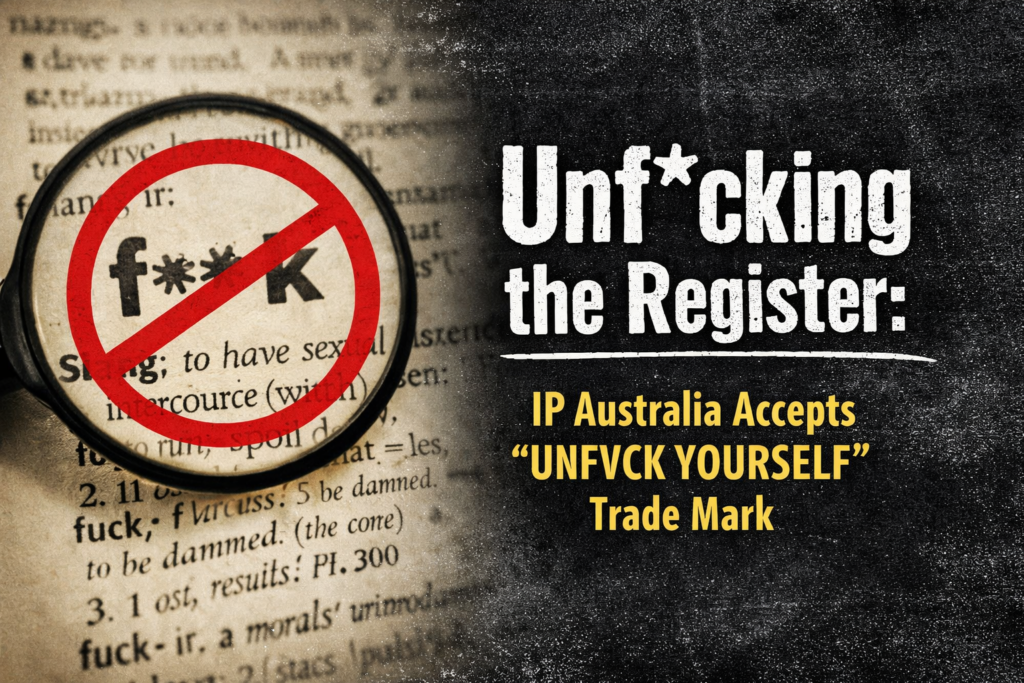
In a recent decision of a delegate of the Registrar of Trade Marks — Renthat Pty Ltd Trade Mark Application (UNFVCK YOURSELF) — IP Australia held that the mark UNFVCK YOURSELF is not “scandalous” within the meaning of s 42(a) of the Trade Marks Act 1995 (Cth) when used in relation to adult-focused goods and services. 

The decision marks a significant development in the interpretation of the long-standing prohibition on scandalous trade marks.

The mark

The applicant, Renthat Pty Ltd, applied to register a figurative mark incorporating the phrase UNFVCK YOURSELF for goods and services including:

  • vitamin and nutritional supplements

  • clothing and merchandise

  • retail and marketing services

An examiner objected under s 42(a), arguing the mark effectively reproduced the word “unfuck yourself”, which the examiner thought would likely offend a section of the community.

Despite three rounds of submissions, the objection was maintained and the matter proceeded to an ex parte hearing under s 33.

Counsel Melissa McGrath, instructed by Scott Coulthart of Mills Oakley, appeared for the applicant.

The legal issue: what counts as “scandalous”?

Section 42(a) requires rejection of trade marks that contain “scandalous matter”.  However, the Act does not define “scandalous”.

The delegate confirmed the accepted test, which is that the mark in question must cause “a significant degree of disgrace, shock or outrage” to an appreciable section of the public — something more than mere offence or bad taste.

That threshold has always left room for debate.

The key question was therefore whether the word “fuck” still meets that threshold in modern Australian society.

Language evolves — and so does trade mark law

The applicant relied heavily on linguistic evidence from Associate Professor Nick Wilson, who explained that:

  • the word “fuck” has become commonplace in everyday Australian speech

  • contemporary audiences are far less shocked by its use than in previous decades

  • swear words used non-abusively often function as expressions of solidarity or emphasis

Research cited in the decision (and in Associate Professor Wilson’s report) suggested the word rated only 1.7 out of 7 in perceived offensiveness among Australian university students — well below racial or gender slurs.

The delegate agreed that Australian language norms have shifted.  She concluded that most adult consumers would not experience a significant degree of shock or outrage when encountering the word in a commercial context.

But children changed the analysis

The examiner’s objection did not fail entirely.

The delegate identified one problem: the specification included “vitamins for children”, and parents of young children might reasonably object to encountering coarse language when buying products for children.

That context could make the mark “shocking” in that particular commercial setting.

The solution was elegant.  The delegate offered the applicant the opportunity to amend the specification to adult-only goods and services, including:

  • vitamin supplements for adults

  • clothing for adults

  • retail services targeting adults

Once those amendments were made, the objection under s 42(a) fell away, and the mark was accepted for registration.

Why the decision matters

This decision is significant for several reasons.

1. It raises the practical threshold for “scandalous”

The delegate effectively confirmed that coarse language alone is not enough.

A mark must cause genuine shock or outrage, not merely offend sensibilities.

2. Context matters more than ever

The decision emphasises the importance of context, including:

  • the nature of the goods and services

  • the target market

  • where consumers encounter the mark

The same word may be acceptable in one context and unacceptable in another.

3. Specifications can solve morality objections

The decision shows that specification amendments can resolve objections.

Limiting goods and services to adult audiences may allow marks containing strong language to proceed.

4. Examiner practice may need to change

Historically, IP Australia examiners have been cautious with profanity-based marks.

This decision signals that automatic objections based solely on swear words may no longer be sustainable.

Applicants may now feel more confident pushing such objections to hearing.

The broader trend

The decision also reflects a broader international trend.

In recent years:

  • the US Supreme Court struck down prohibitions on “immoral” and “scandalous” marks

  • courts have increasingly recognised that language evolves

Australian law still retains the statutory prohibition, but Renthat shows that its application is becoming significantly narrower.

Final thoughts

Trade mark law does not exist in a cultural vacuum.  As language changes, so too must the legal standards applied to it.

This decision may not entirely unf*ck trade mark law, but it certainly nudges the register a little closer to reflecting the way Australians actually speak.
Filed Under: IP, Trade Marks Tagged With: IP, Trade Marks

March 12, 2026 by Scott Coulthart

Firework Fizzles (For Now): The High Court Re-stitches the Katy Perry Trade Mark Battle

The long-running trade mark dispute between Australian designer Katie Taylor (born Katie Perry) and global pop star Katy Perry (Katheryn Hudson) has now reached the High Court of Australia — and the result is a dramatic twist.

In Taylor v Killer Queen LLC [2026] HCA 5, the High Court has allowed Taylor’s appeal, setting aside the Full Federal Court’s decision that had ordered cancellation of her “KATIE PERRY” clothing trade mark.

The matter now returns to the Full Court to determine the remaining issues — meaning the fight isn’t quite over yet.

But the High Court’s reasoning significantly reshapes how courts should approach reputation-based cancellation and trade mark confusion involving celebrities.

Let’s unpack it.

🎤 The Background: Pop Star vs Fashion Label

This dispute has been simmering for more than 15 years.

In 2007–2008:

  • Australian designer Katie Taylor launches a clothing brand using her birth name KATIE PERRY.

  • She applies to register the word mark for clothing in September 2008.

Meanwhile:

  • US singer Katy Perry is exploding globally with hits like I Kissed a Girl.

  • Her fame reaches Australia during the same period.

The problem?  The names are aurally identical and visually very close.

Taylor’s mark was eventually registered in 2009, and for years the two brands co-existed uneasily.

Then in 2019, the singer’s companies launched proceedings seeking to cancel the registration.

⚖️ What Happened in the Courts

The litigation has already taken several turns.

Federal Court (trial)

The trial judge:

  • found infringement by Perry-related merchandise sellers; but

  • refused to cancel Taylor’s trade mark.

The key finding was that, although the singer had a reputation in Australia in music and entertainment, she did not have a reputation in clothing at the priority date.

Full Federal Court

On appeal, the Full Court reversed that result, holding that:

  • Katy Perry’s reputation as a global pop star was sufficient;

  • consumers would expect pop stars to sell merchandise like clothing; and

  • the marks were so similar that confusion was likely.

Result: Taylor’s trade mark was ordered cancelled.

👑 The High Court Decision

The High Court has now allowed Taylor’s appeal and set aside that cancellation order.

The Court split in its reasoning, but the majority rejected key aspects of the Full Court’s approach.

The case has been remitted to the Full Federal Court to reconsider outstanding issues.

In practical terms, Taylor’s trade mark survives — at least for now.

The appeal centred on three important provisions of the Trade Marks Act 1995 (Cth):

  • s 60 — opposition based on reputation

  • s 88(2)(a) — cancellation based on grounds that could have opposed registration

  • s 88(2)(c) — cancellation where current use would cause confusion

  • s 89 — discretion not to cancel

The decision digs deeply into how reputation and confusion should actually be assessed.

1️⃣ Reputation Must Be Carefully Identified

The Court confirmed that s 60 requires reputation in a trade mark, not merely general fame.

“Reputation” in this context means recognition of the mark by the public, reflecting its “credit, image and values”. 

The crucial question, though,  is “Reputation for what?”.

In this case, the singer’s mark clearly had reputation in music and entertainment, but there was debate about whether that reputation extended to clothing.

The High Court emphasised that reputation does not automatically spill across industries simply because celebrities often expand their brands.

2️⃣ Confusion Must Arise Because of the Reputation

Another key point was that the likelihood of deception must arise because of the prior mark’s reputation, not merely because the marks look similar.

In other words, similarity alone is not enough — the reputation must drive the confusion.

The Court reiterated the classic test – would a reasonable number of people wonder if a trade connection exists?

This inquiry is assessed by comparing actual reputation of the earlier mark with notional normal and fair use of the challenged mark.

3️⃣ Notional Use Still Matters

A key trade mark principle resurfaced strongly, namely that courts assess how the registered mark could be used, not just how it actually has been used.

That means asking what legitimate uses could the trade mark owner make of the mark?

This concept of “notional normal and fair use” has long been part of Australian trade mark law, but the High Court’s analysis reinforces its importance.

4️⃣ Section 89 Discretion Remains Narrow

Another major issue was the discretion not to cancel a mark under s 89.

The Full Court had effectively ruled that Taylor’s act of applying for the trade mark — knowing of the singer’s fame — was enough to defeat that discretion.

The High Court’s reasoning suggests that approach may have been too rigid, holding instead that the question is whether the ground for cancellation arose through the registered owner’s “act or fault”.

That issue will now be reconsidered when the case returns to the Full Court.

🧵 Why This Case Matters

This decision will have ripple effects far beyond celebrity disputes.

It highlights several key principles:

  • Fame ≠ automatic trade mark dominance – A celebrity’s reputation does not automatically block registrations in unrelated markets.
  • Reputation must be analysed carefully – Courts must identify what goods or services the reputation actually relates to.
  • Confusion must flow from reputation – Section 60 is not simply a deceptive similarity test.
  • Cancellation powers are not automatic – Even where confusion might arise, discretionary factors still matter.

🎬 Final Stitch

At one level, this case is a quirky battle between two women with nearly identical names.

At another, it raises profound questions about how trade mark law treats celebrity brands.

Should global fame give artists a shadow monopoly across merchandising categories?

Or should trade mark rights remain tied to actual commercial use and reputation?

The High Court hasn’t ended the fight — but it has reshaped the legal framework in which it will be decided.

For now, at least, Katie Perry the designer still has her label.

Filed Under: Entertainment, IP, Trade Marks, Uncategorized Tagged With: Entertainment, IP, Trade Marks

Primary Sidebar

Recent Posts

  • Unf*cking the Register: IP Australia Accepts “UNFVCK YOURSELF” Trade Mark
  • Firework Fizzles (For Now): The High Court Re-stitches the Katy Perry Trade Mark Battle
  • 🏇 When the Race Stops a Nation — Who Owns the Moment?
  • AI Training in Australia: Why a Mandatory Licence Could Be the Practical Middle Ground
  • AI-Generated Works & Australian Copyright — What IP Owners Need to Know

Archives

  • March 2026 (2)
  • November 2025 (1)
  • October 2025 (14)
  • September 2025 (21)
  • August 2025 (18)
  • July 2025 (16)
  • June 2025 (21)
  • May 2025 (12)
  • April 2025 (4)

Footer

© Scott Coulthart 2025