• Skip to primary navigation
  • Skip to main content
  • Skip to primary sidebar
  • Skip to footer

IPMojo

  • About IP Mojo
  • About Scott Coulthart
  • CONTACT
BOOK AN APPOINTMENT

Scott Coulthart

July 15, 2025 by Scott Coulthart

Brand Control, Part 5: “The Subtle Art of Brand Control” — Trade Mark Ownership and Assignment

Trade marks are valuable assets — but like any asset, their value depends on who owns them.

Too often, businesses assume that if they’re using a brand, they own it. But that assumption can fall apart quickly in the face of legal scrutiny, especially when an investor, acquirer or opposing lawyer starts asking questions.

Getting trade mark ownership wrong isn’t just a technical slip. It can torpedo a funding round, delay a sale, or even expose a business to infringement claims from within its own camp.

🔗 Common Ownership Traps

Let’s start with a few real-world scenarios where ownership can become dangerously unclear:

1. Employees vs Contractors
If an employee develops a brand name or logo in the course of their employment, the default position is that the employer owns it. But if you used a contractor — say, a freelance designer or marketing agency — then unless there’s a clear written agreement transferring IP, they may legally own the mark.

This is especially true if the contractor applied to register the trade mark themselves — and it happens more often than you’d think.

2. Founders and Side Projects
A founder might register the brand name in their own name early on, before the business is incorporated. That might seem harmless — until the business seeks capital, or goes to sell, and it turns out the company doesn’t actually own its own brand.

Investors will spot this immediately in due diligence. So will buyers. And neither of them will want to negotiate with a founder’s ego when they’re paying for a company asset.

3. Joint Ventures
When two businesses collaborate on a new offering, they often co-create a brand. But without an express agreement, who owns it? Half each? One party? Neither?

Ambiguity in a joint venture brand is a recipe for dispute — particularly if one party starts using the brand solo down the track.

📑 Assignments and Transfers: Cleaning Up the Chain of Title

The good news? Trade marks are assignable — they can be transferred from one entity to another like any other form of property.

But they need to be:

  • Documented in writing — via a deed or agreement; and

  • Formally recorded with IP Australia (if the mark is registered).

Some common triggers for assignment include:

  • Business restructures (e.g. transferring IP from founders to the company, or from one group company to another)

  • Sale of business or assets

  • Fixing past mistakes (e.g. if a mark was filed by one entity but you want the trade mark held by another entity)

You can’t just tell people a trade mark belongs to your company. If it was registered under someone else’s name — a founder, contractor, or prior owner — you need to assign it, and record the transfer.

🚫 Assignments Don’t Cure Invalidity

Be careful — an assignment won’t fix an invalid application.

If a trade mark application is filed in the name of a party who is not the true owner of the mark at the time of filing, the application is invalid. You can’t fix that simply by assigning it later to the correct entity. The application is fatally flawed from the start — and may be removed or opposed on that basis.

So how do you know who the “true owner” is?

Ask:

  • Who created the mark?

  • Was it created by an employee, contractor, or external agency?

  • Was it commissioned, and if so, under what terms?

  • Who controls the use of the mark in trade?

  • Who will actually use the mark in connection with goods or services in Australia?

In most cases, the true owner is the entity that first intends to use the mark, or controls its use in trade and commerce. If you’re registering for a company that doesn’t exist yet — wait until it’s incorporated. If you’re using a contractor, make sure IP is assigned before the application is lodged.

If you’ve already used the mark as a trade mark before getting your corporate structure sorted, then the person or entity that first used it is probably the true owner. In that case:

  • Either apply in that party’s name, or

  • Assign the trade mark to your intended applicant before filing.

In either case, get tax and accounting advice first — there could be capital gains tax or other structuring implications worth considering before assigning IP or applying under the wrong name.

💡 IP Mojo Tip

Own the brand before you build the brand.

  1. Identify the true owner on day one – the party that first creates and controls use of the mark.

  2. Put it in writing – deed of assignment or employment/contractor clauses that clearly vest IP.

  3. Record it – lodge the assignment (or the application) in the correct name with IP Australia straight away.

  4. Audit early, audit often – confirm ownership before every financing, restructure, or marketing push.

If you nail these four steps, you’ll avoid the “who-really-owns-it?” drama that derails deals and drains legal budgets.

Filed Under: IP, Trade Mark Series, Trade Marks Tagged With: IP, Trade Mark Series Part 5, Trade Marks

July 15, 2025 by Scott Coulthart

Contract First, Practice Later? Why You’ve Got It Backwards

When a new business relationship begins, it’s tempting to grab a contract off the shelf, tweak a few names and dates, and call it a day. After all, the “real work” is about to start — the paperwork just needs to keep up. Right?
Or maybe you take a contract you’ve seen someone else use, and decide to change your business practices to comply with their terms. That makes sense, doesn’t it?

No — not quite.

A contract shouldn’t trail behind the deal like an afterthought. But it also shouldn’t reshape the deal without giving that deal any thought. A well-drafted contract should define and support the arrangement — tailored to how the service will actually be delivered, who will deliver it, how value will be created, and how risk will be managed.

Otherwise, you risk ending up with a document that’s legally tidy but practically unworkable — or worse, a source of confusion and liability down the track.

Here’s why the contract should follow the practice, not force it.


🎯 1. The Contract Should Reflect the Practice — Not Dictate It

Contract drafting isn’t an exercise in creative writing. It’s a legal mirror held up to your actual business model.

If the agreement assumes a formal signoff process but you operate with agile, iterative sprints — you’re going to breach your own contract just by doing business as usual.

If the contract says “transfer of IP on full payment” but payment is milestone-based and you’ve already handed over the work — you’ve just created ambiguity around ownership.

Rule of thumb: don’t draft a contract until you understand exactly how the service will be performed — including team structure, communication cadence, approvals, deliverables, timing and client involvement.


🧱 2. Contracts Are Guardrails, Not Strangleholds

A good contract provides structure, accountability and fallback positions — but it should never get in the way of the commercial reality.

That means building in flexibility where needed:

  • SaaS development that permits user testing before signoff

  • Design services that include concept revisions without resetting timelines

  • Joint R&D where IP rights reflect actual contribution, not just billing rates

When the contract forces an artificial or overly rigid process, it can delay projects, sour relationships and ultimately undermine the client’s goals.


⚠️ 3. Misalignment Can Lead to Legal and Commercial Risk

If your practice and your paperwork aren’t aligned, it can backfire — fast:

  • You might lose leverage in a dispute because your contractual obligations were never realistically achievable.

  • You could accidentally license more than intended, or assign rights prematurely.

  • Your service model may breach regulatory obligations, especially around data handling, privacy, or consumer guarantees.

And in litigation, courts often look past the black-letter terms to how the parties actually behaved. A contract that doesn’t match conduct can be more of a liability than a safeguard.


🛠️ 4. Tips for Getting it Right

  • Start with a reality check. Understand your own processes — or your supplier’s — before putting pen to paper.

  • Workshop the workflow. Map out the actual steps of delivery and make sure your contract reflects them.

  • Speak human. Avoid boilerplate that doesn’t fit your practice. Contracts should be clear, not cryptic.

  • Review regularly. As your service model evolves, your contracts should too.


🚫 Don’t Retrofit. Design Fit-For-Purpose.

The best contracts aren’t theoretical constructs — they’re practical frameworks. They don’t try to reinvent how you work. They protect how you actually do business.

So don’t write the contract first and force the practice to conform.

Understand the practice. Then draft the contract to match.

Filed Under: Commercial Law, Contracts Tagged With: Commercial Law, Contracts

July 14, 2025 by Scott Coulthart

Brand Control, Bonus Part 4A: “Black, White, or Brand Colours?” — Filing Your Trade Mark in the Right Format

When it comes to registering your logo as a trade mark, most people obsess over what to file — but give little thought to how they file it.

That might sound cosmetic. It’s not.

Whether you lodge your logo in colour, greyscale, or black and white can significantly affect your legal rights — especially when it comes time to enforce them or defend against a non-use challenge.

⚖️ Why Format Matters

The version of your logo that you register defines the scope of your protection. That includes not only the design itself, but also the colour (or lack of it). Get this wrong, and you may end up with a trade mark that’s narrower than you think — or worse, vulnerable to attack.

Let’s break down the key options.


🖤 Filing in Black and White (or Greyscale)

This is the default for many businesses — and with good reason.

Pros:

  • Broader protection: A black-and-white filing generally covers all colour variants, meaning you can enforce your rights even if you present the logo in red, green, blue, or rainbow.

  • Future-proofing: Gives you flexibility if your brand palette evolves.

  • Administrative simplicity: No need to worry about strict consistency between your filed version and the colours you actually use.

Cons:

  • If colour is a core brand element (think Cadbury purple or Tiffany blue), filing in black and white might dilute your distinctiveness case.

  • In the EU and some other jurisdictions, courts and registries have begun interpreting black-and-white marks more narrowly — treating them as literally black-and-white. That means that in those jurisdictions, using your mark in colour may not constitute use of your registered black-and-white version.  This trend hasn’t reached Australia (yet), but it’s worth noting.

🎨 Filing in Colour

In some cases, colour isn’t just decoration — it’s branding. If your logo’s colour scheme is heavily marketed and instantly recognisable, a colour filing might be worth it.

Pros:

  • Supports claims to distinctiveness through colour — which can help if you’re pursuing colour trade mark protection in its own right.

  • Reflects real-world use if your brand always appears in that colour scheme.

Cons:

  • May limit your rights in some jurisdictions — but not in Australia, where a logo filed in colour will generally still cover variations in other colours unless colour has been expressly claimed as part of the trade mark.

  • In Australia, there’s no general risk of non-use removal for using your logo in different colours — unless your registration specifically claims colour as a feature. That said, it’s still cleaner (and less arguable) to use the mark in a form close to the one registered.


🎯 Some Things to Watch

1. Evidence of Use Needs to Align (More or Less)

If your logo is registered in colour but you only ever use it in black and white (or vice versa), and you’re defending against a non-use removal action, your evidence might still be accepted — but it’s always safer if the colours match, or if colour wasn’t part of the mark to begin with.

2. Madrid Protocol and International Filings May Be Affected

Whichever registration forms your Madrid Protocol base — whether or not it’s an Australian application — the representation you file (including colours) will carry through to your international applications.

Some jurisdictions treat colour as limiting, even if Australia doesn’t. In the EU, China, South Korea and others, colour is more tightly tied to the rights you’re granted. So what might be broad in Australia could be narrow overseas if you rely on a colour version as your base.

🧭 Rule of thumb: File in each jurisdiction — including separately if necessary — in the same format in which you propose to use the mark there.

3. Misalignment with Brand Identity

If your brand identity is highly colour-driven (again, Cadbury purple or Tiffany blue), filing a version in colour without claiming the colour might undercut future arguments that the colour is distinctive.

You can’t have it both ways: either colour matters, or it doesn’t. If it does, claim it. If it doesn’t, don’t build your distinctiveness case on it later.


✅ Best Practice in Australia

So, what should you do?

  • If colour isn’t essential to your brand’s identity: stick with black and white (or greyscale) for broader and more adaptable coverage — unless you’re filing via the Madrid Protocol and plan to use the mark in colour in a colour-sensitive jurisdiction. In that case, you may need to file your base application in colour too — as long as that won’t cause issues in your base jurisdiction.

  • If colour is central to your brand strategy: consider filing both a colour version and a black-and-white version — or prepare strong use evidence to back your colour claim.

  • If your logo use varies across products or channels: a black-and-white filing gives you the most legal breathing room in Australia. Or, if your variants differ materially, file multiple versions (or a series application, where appropriate).

⚠️ Filing in multiple formats may mean more upfront cost — but it could save you a fortune later if your brand is challenged or infringed.


💡 IP Mojo Tip

Don’t confuse design preference with legal strategy. Your brand might look best in colour — but from a legal perspective, black and white may give you more options.

That said, the best general rule is this: File it how you propose to use it.
If you know the colour combinations you plan to use for the medium term, consider a series application covering those variants — or file multiple applications if that’s cleaner for your international strategy.

Filed Under: IP, Trade Mark Series, Trade Marks Tagged With: Bonus Post, IP, Trade Marks, TradeMark Series Part 4A

July 11, 2025 by Scott Coulthart

Bogus Brands, Fake Flyers, and Deepfake Danger: The Law Behind the Nathan Cleary Image Scandal

Rugby league star Nathan Cleary is the latest Australian celebrity to have his image hijacked for commercial gain without consent — a reminder that in the AI age, the unauthorised use of someone’s likeness isn’t just a reputational risk. It’s often unlawful, and sometimes even criminal.

Just hours after this year’s Origin decider, fans returned to their cars at Sydney Olympic Park to find a flyer featuring a doctored image of Cleary, seemingly endorsing novelty car accessories. The image was fake. The quote was fake. The endorsement never happened. But the legal implications are very real.

So what’s actually being breached when someone misuses your face — and what can you do about it?

📸 No Statutory “Right of Publicity” — But You Still Have Legal Options

Australia doesn’t have a US-style statutory “right of publicity” or standalone image right. But celebrities aren’t powerless.

Legal remedies typically come from three key areas:


⚖️ 1. Misleading and Deceptive Conduct (Australian Consumer Law)

Section 18 of the Australian Consumer Law prohibits conduct that is misleading or deceptive, or likely to mislead or deceive.

Using a person’s likeness — especially a high-profile figure like Nathan Cleary — in a way that suggests endorsement or association, when no such endorsement exists, will almost always be misleading.

This can apply even if no goods are sold, but the impression of association is strong enough to influence consumer behaviour.

Penalties can include injunctions, corrective advertising, damages, and fines for corporations and individuals.


🧠 2. Passing Off

A common law cause of action, passing off protects the goodwill a person or brand has built up. To succeed, you must show:

  • Reputation in the market

  • Misrepresentation (by the other party)

  • Damage to your goodwill or reputation

It’s often used by celebrities to stop unauthorised commercial use of their name or likeness. For sportspeople like Cleary — who command lucrative brand partnerships — unauthorised endorsements can undercut carefully curated sponsorship relationships.


🎨 3. Copyright and Doctored Images

If the image used was a reproduction or adaptation of a copyright-protected photo — for instance, one originally taken by a professional photographer — the flyer could infringe copyright as well.

Even digitally manipulated images (such as AI-generated or Photoshopped versions) may still reproduce a substantial part of the original.


🔒 Criminal Deception?

Cleary’s legal team has suggested this may also amount to obtaining a benefit by deception — a criminal offence under various state and territory laws.

That’s especially relevant where:

  • The misrepresentation is intended to induce consumers to buy something

  • The product may be part of a scam or fraudulent site

  • Consumers are financially harmed

This isn’t just civil IP — it’s potentially identity-based fraud.


🤖 AI Makes This Easier — and Worse

The ability to fake an endorsement has never been more accessible. AI image generators and editing tools now allow anyone to quickly create plausible likenesses of celebrities, insert fake quotes, or digitally recreate products.

What used to require a designer and Photoshop now takes 10 seconds and a prompt.

Without robust protections or swift enforcement, athletes and entertainers risk becoming unwilling frontmen for scammy brands or shady products — with little control over how or where their likeness appears.


🛑 So What Can Be Done?

For talent: Quick legal action is key. That includes cease-and-desist letters, takedown requests, and (where needed) court proceedings. Keep records of your brand deals — including exclusivity — and monitor the use of your name and likeness online.

For businesses: Don’t use a person’s image, name, voice, or persona to promote goods or services unless you’ve secured clear written consent. Even “harmless” nods or jokes can land you in hot water if the impression is that they’ve endorsed your product.

For regulators and sporting bodies: There’s a strong case for greater protection — not just for economic harm, but for consumer trust and brand integrity. Fans deserve to know when a product is genuinely endorsed, and when it’s just a digital fake.


Final Whistle

This isn’t just about one player and one flyer.

It’s a wake-up call about how easily digital tools can blur the line between real and fake — and why the law must be ready to blow the whistle when someone takes the mickey with a public figure’s face.

Filed Under: AI, IP Tagged With: AI, IP

July 10, 2025 by Scott Coulthart

Brand Control, Part 4: “Lock It In” — How and When to Register Your Trade Mark

You’ve chosen your name. You’ve cleared it. You’re confident it’s distinctive and available. Now it’s time to make it yours — legally.
A strong brand name or logo might help you win customers, but unless it’s properly registered, it won’t help you win disputes. And the longer you delay, the more you risk someone else locking it up first.

When Should You Register?

The short answer: as early as you can. Ideally, you’d file before launch — while you’re still in development — so you can resolve any issues before your brand goes public. But that’s not always practical.

  • Before launch: Best practice. Gives you a chance to pivot if there’s a conflict.

  • Right after launch: Still fine — but the longer you wait, the more you risk third-party interference or knock-offs.

  • After years of use: Better late than never. Prior use may support your rights, but without registration, they’re much harder to enforce.

And remember: while Australia protects first use, many countries follow a strict first-to-file rule. If someone else files your brand overseas before you do — even without using it — you may lose your chance to register or enforce it.

Trade mark “squatting” is a thing – a thing preferably to be avoided.

Where Should You Register?

Start with the country you’re operating in — typically your home market. In Australia, that means filing with IP Australia under the Trade Marks Act 1995.

If you’re looking to expand globally, consider the Madrid Protocol — an international filing system that lets you apply in multiple countries via a single application. You must first have a home-country application or registration, and your international rights will depend on that base filing.

However, Madrid isn’t always the right tool for every country or situation. In some markets, a direct national filing is still better — especially if you’re concerned about local examination delays, enforcement practicalities, or use requirements.

🧳 We’ll go deeper on global strategy in Part 9: From Garage to Global.

What Kind of Trade Mark Should You File?

There’s more than one way to register a mark. The form you file should match your brand strategy:

  • Standard mark: For word-only marks (names, taglines). Best for maximum flexibility.

  • Device mark: For logos, custom fonts, or stylised branding elements.

  • Series mark: For similar marks with small variations (e.g. Tasty Treats vs Tasty-Treats). Less common, and sometimes more trouble than they’re worth.

  • Defensive mark: Available only for famous brands, offering broader coverage across unrelated classes.

  • Certification mark: Used to indicate goods or services meet a recognised standard (e.g. organic, halal). Strict rules apply.

One thing to watch when filing a logo or device mark: if you file it in colour, your rights may be limited to that specific colour scheme. Unless colour is a core part of your brand identity, it’s usually better to file in black and white or greyscale — so your protection extends to all colour variants.

Like most things, there are exceptions to this.

🎨 We’ll cover colour vs greyscale filing in more depth in an upcoming bonus post.

💡 IP Mojo Tip

The earlier you file, the stronger your position — and the safer your brand. Waiting until you’re “big enough to matter” might just make you a bigger target. Brand protection isn’t a vanity move — it’s risk management with long-term payoff.

Filed Under: IP, Trade Mark Series, Trade Marks Tagged With: IP, Trade Mark Series Part 4, Trade Marks

July 9, 2025 by Scott Coulthart

IMDb v DMDb: One Letter’s Difference Not Enough

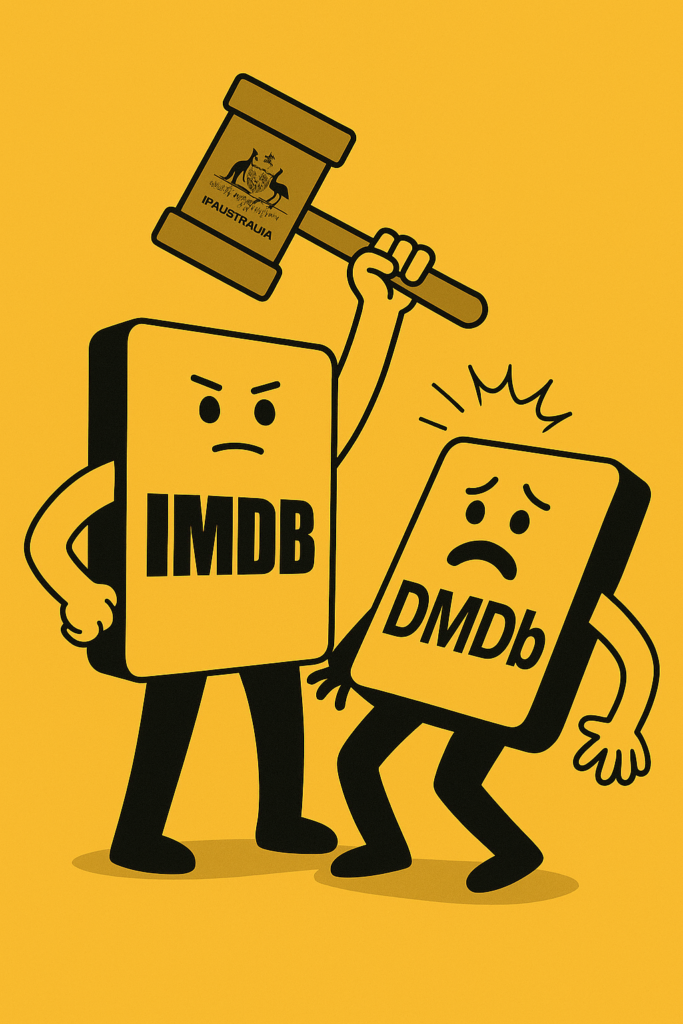
Zumedia Inc’s attempt to register DMDb as a trade mark in Australia fell flat—thanks to its awkward proximity to a far more famous acronym: IMDb.

Zumedia, a Canadian company behind a digital media platform called “Digital Media Database,” applied to extend its international trade mark registration for DMDb into Australia. But IMDb, the internet’s go-to entertainment database, wasn’t about to let that slide. Backed by nearly 30 years of global use and widespread recognition in Australia, IMDb opposed the extension under section 60 of the Trade Marks Act 1995.

IP Australia sided with IMDb. Despite the difference in the first letter, Delegate Tracey Berger found the marks visually and aurally similar, especially given the overlapping services—both related to searchable databases of entertainment content. Australian users, she held, could easily assume DMDb was affiliated with or endorsed by IMDb.

Zumedia tried to argue that DMDb was a unique acronym and that “Db” simply stood for “database.” Ironically, that only strengthened the opposition’s case: as the Delegate pointed out, consumers often remember brands imperfectly. The shared “-MDb” element was enough to trigger a mistaken belief in a connection.

She also referenced prior cases—including AAMI and Tivo v Vivo—to reinforce the point: when a well-known mark has a strong reputation in the same field, even small differences won’t eliminate the risk of confusion.

The outcome?  Extension of protection refused. Costs awarded against Zumedia.

🎬 IP Mojo Takeaway: If your brand sits one letter away from an iconic name in the same industry, don’t count on slipping through. Trade mark law doesn’t look kindly on near-misses that come too close to the main act.


Filed Under: Entertainment, IP, Trade Marks Tagged With: Entertainment, IP, Trade Marks

  • « Go to Previous Page
  • Go to page 1
  • Interim pages omitted …
  • Go to page 9
  • Go to page 10
  • Go to page 11
  • Go to page 12
  • Go to page 13
  • Interim pages omitted …
  • Go to page 19
  • Go to Next Page »

Primary Sidebar

Recent Posts

  • Unf*cking the Register: IP Australia Accepts “UNFVCK YOURSELF” Trade Mark
  • Firework Fizzles (For Now): The High Court Re-stitches the Katy Perry Trade Mark Battle
  • 🏇 When the Race Stops a Nation — Who Owns the Moment?
  • AI Training in Australia: Why a Mandatory Licence Could Be the Practical Middle Ground
  • AI-Generated Works & Australian Copyright — What IP Owners Need to Know

Archives

  • March 2026 (2)
  • November 2025 (1)
  • October 2025 (14)
  • September 2025 (21)
  • August 2025 (18)
  • July 2025 (16)
  • June 2025 (21)
  • May 2025 (12)
  • April 2025 (4)

Footer

© Scott Coulthart 2025