• Skip to primary navigation
  • Skip to main content
  • Skip to primary sidebar
  • Skip to footer

IPMojo

  • About IP Mojo
  • About Scott Coulthart
  • CONTACT
BOOK AN APPOINTMENT

Scott Coulthart

May 18, 2025 by Scott Coulthart

Sad Bot, Caged Thought: The Global Crackdown on AI

We’re living through the Great AI Whiplash. After a few years of “move fast and break things” AI hype, the regulators have woken up — and they’re looking a little nervous.

Around the globe, lawmakers are scrambling to rein in artificial intelligence, fearing a digital Frankenstein’s monster. But the problem? No one can quite agree on which monster they’re dealing with — or how to shackle it without killing the spark that brought it to life.

Europe: The AI Act is Here, and It Means Business

The EU has locked in its AI Act, the world’s first major attempt at a cross-sector regulatory framework for artificial intelligence. It’s classic Brussels: tiered risk models, sweeping definitions, and enough compliance paperwork to make your chatbot cry. High-risk systems — think facial recognition or algorithmic credit scoring — face tight controls, while general-purpose models like ChatGPT must disclose training data, provide documentation, and prevent unlawful output.

It’s bold, it’s bureaucratic, and it’s already making developers nervous. The result? A brain drain of AI startups testing the waters elsewhere — or geofencing Europe altogether. You can regulate risk, but you can’t regulate innovation into existence.

UK: “Light Touch” with a Side of Confusion

Meanwhile, across the Channel, the UK wants to be the Goldilocks of AI regulation: not too hot, not too cold. The approach is “context-specific” — no overarching law, just guidance for existing regulators. But insiders say the result feels like regulatory hopscotch. Now, the House of Lords is up in arms over data mining for AI training. An amendment that would’ve required consent to scrape copyrighted works was shot down — despite a Beatles-backed campaign. A softer version might still pass.

So far, the UK’s trying to play tech cheerleader and cautious referee. But if everyone’s a stakeholder, who’s actually accountable?

US: States vs Feds, and the Lobbyists Are Winning

In Washington, it’s chaos as usual. President Biden’s Executive Order on AI was a decent start — calling for safeguards around national security and discrimination. But Congress? Still dithering. House Republicans recently tried to sneak a 10-year ban on state-level AI regulation into a tax bill (!), prompting a bipartisan outcry from attorneys general across 40 states. Why? Because the states are the ones doing the real work — regulating facial recognition, policing AI in employment, and pushing back on Big Tech’s black boxes.

Then there’s copyright: The U.S. Copyright Office is in a full existential crisis over whether AI-generated content can be protected and whether training data sourced from creative works amounts to fair use or industrial-scale infringement.

The Rest of Us

Australia, Canada, Singapore — all watching and waiting. Some are rolling out AI ethics frameworks. Others are updating privacy laws or leaning on competition watchdogs. Everyone’s talking transparency, risk, and bias. No one’s solved the training data problem. And no country has yet nailed a working model for how AI intersects with IP rights — especially when the training data is your music, your writing, or your likeness.

Author’s View – The Risk of Overcorrection

AI is scary, sure. But if you treat every algorithm like a grenade, you end up regulating fear, not function. Good regulation shouldn’t make developers hide or flee — it should set standards that encourage safe, creative, accountable use. The IP world knows this better than most: you can reward innovation and protect creators. But try to do both with clumsy laws or reactive bans, and you get what we’re seeing now — paralysis dressed as progress.

And so, here we are: a sad little AI bot, behind bars. Not because it committed a crime. But because the grown-ups can’t agree on the rules.
Filed Under: AI, Copyright, Regulation Tagged With: AI, Copyright, Regulation

May 12, 2025 by Scott Coulthart

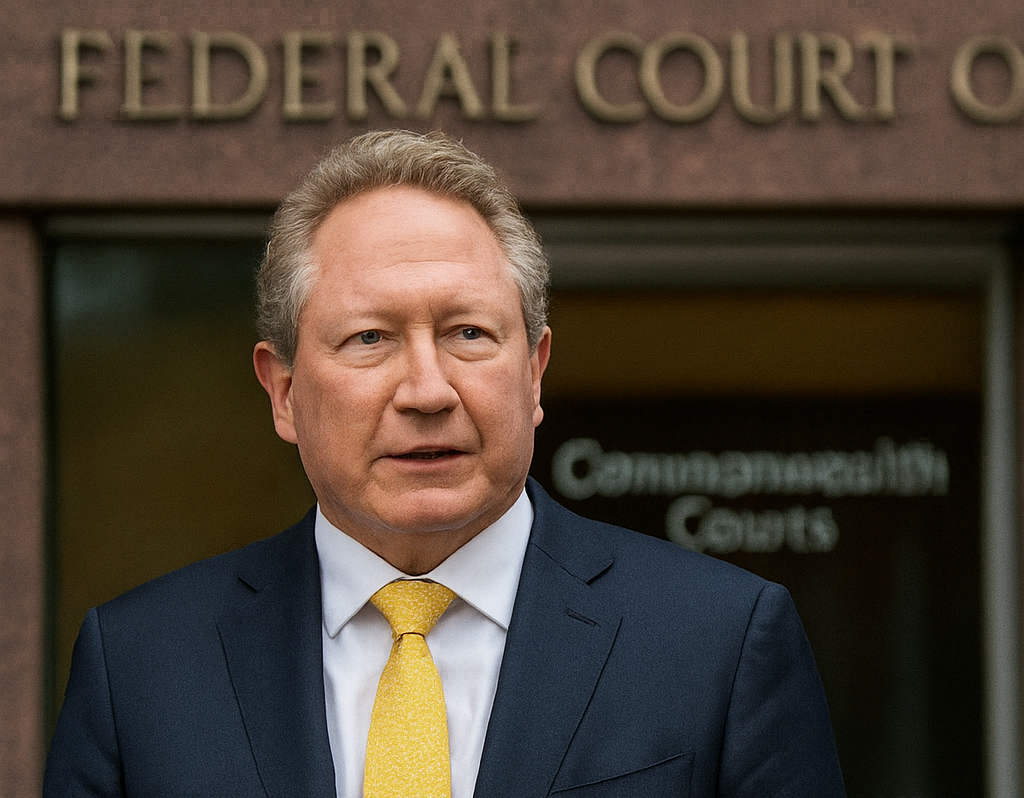
Fortescue vs Element Zero: When Iron Meets IP

In a drama more suited to Silicon Valley than the Pilbara, Fortescue Metals Group is facing off in court against Element Zero, a green-tech startup founded by two of its former senior executives.

The heart of the dispute? Allegations that the ex-Fortescue pair took proprietary technology and confidential know-how with them when they walked out the door — and used it to launch a direct competitor in the decarbonised iron ore space. Fortescue’s claim includes serious accusations of IP theft, misuse of confidential information, and a familiar subplot of boardroom ambition turned courtroom battle.

So far, so standard — but here’s where it gets interesting. Fortescue has been accused of using its size and resources to play the long game, including deploying delay tactics and procedural complexity to push the trial all the way to May 2026. Element Zero has cried foul, claiming it’s a classic case of litigation-as-strategy: slow down the underdog until their innovation pipeline or funding dries up. Whether or not that narrative sticks, it’s a reminder that in IP litigation — particularly in high-stakes tech or science-based fields — process can become a weapon as potent as any cause of action.

The technology at the centre of the case involves so-called “Electra” chemical processes that promise zero-emission iron production — IP that, if proven proprietary to Fortescue, could be worth billions. But this raises a fundamental legal question: what is proprietary in a technical process? And when can it be said to be owned by a company rather than the individuals who helped develop it — especially if no patent has (yet) been granted, and the invention is shrouded in secrecy? In Australia, trade secret protection requires not just that the information be confidential, but that reasonable steps were taken to maintain that confidentiality — and that’s often where cases fall down.

From a broader perspective, this case underscores a key lesson for companies working at the bleeding edge of tech or resource innovation: if your value is in your know-how, then lock it down. IP ownership clauses in employment contracts, internal controls on access, documentation of invention history, and even early patent filing (or defensive publication) can all tip the scales in your favour later. And for founders or executives planning to launch a spinoff? It pays to get early legal advice — because “we came up with it ourselves” won’t hold water if the tech smells a lot like your old job.

Whether this one ends with a licensing deal, an injunction, or just a big legal bill and a few scorched reputations, it’s a timely reminder that the path from lab bench to market often runs straight through the courtroom. In the IP space, fortune favours not just the bold — but the prepared.

Filed Under: Uncategorized

May 11, 2025 by Scott Coulthart

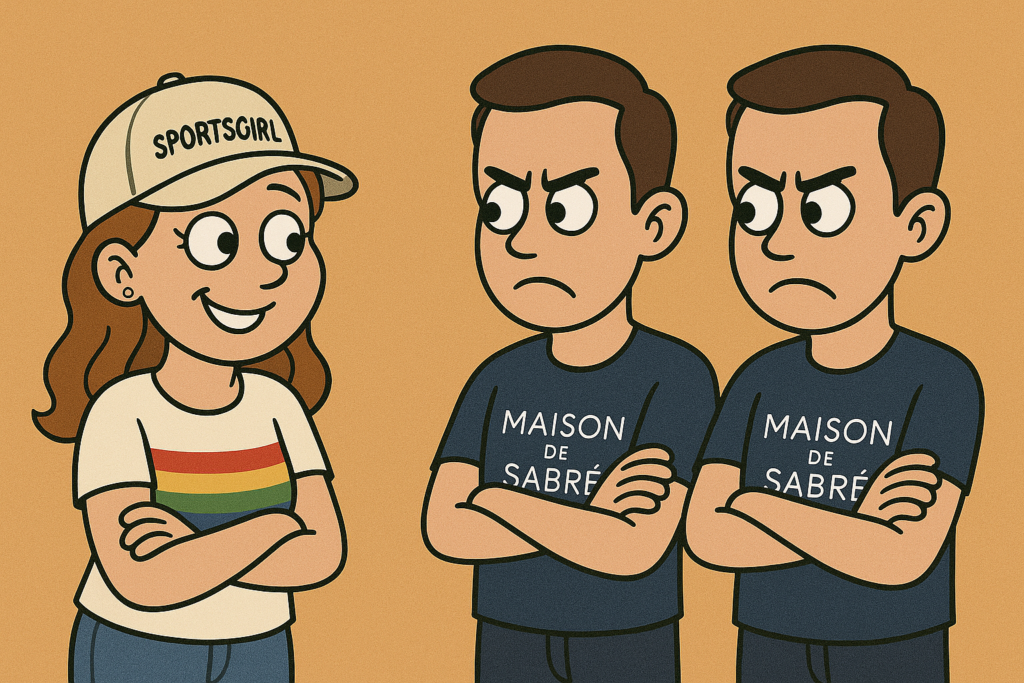
Sportsgirl Got Sabred

Not a food fight this time, but there’s real passion in fashion in the recent spat between Sportsgirl and high end Sydney brand Maison de Sabre.

Sportsgirl has recently removed from sale some miniature wallets shaped like fruit after Maison de Sabre accused them of copying their products.

Maison de Sabre says that in 2023 it launched its now very popular fruit-shaped charms, which are quite distinctive.  More recently, Sportsgirl started selling miniature wallets, some of which are seen below side by side with the relevant Maison de Sabre products (obviously the Sportsgirl products don’t have “Maison de Sabre” printed on them).


Images: Courier Mail

Well, imagine that – Sportsgirl releases some products strikingly similar to Maison de Sabre’s best-sellers. No logos are copied, and the products aren’t passed off by Sportsgirl as being those of Maison de Sabre (we can assume Sportsgirl hung a Sportsgirl label on them), and Maison de Sabre is renowned for these designs. Is Sportsgirl legally in the wrong?

What About Copyright?

In Australia, copyright protects original artistic works. However, once a design is industrially applied—meaning it’s mass-produced—copyright protection typically doesn’t apply. So, if Maison de Sabre’s design has been sold widely, it’s likely not protected by copyright anymore.

Passing Off / Misleading or Deceptive Conduct?

Passing off occurs when one brand misrepresents its products as those of another, causing consumer confusion. But if Sportsgirl clearly branded the products and didn’t suggest any association with Maison de Sabre, it’s challenging to claim passing off.

For the same reasons, it could be difficult to establish misleading or deceptive conduct, or false representations, in breach of the Australian Consumer Law.

Registered Designs: Your Fashion Shield

The most robust protection for product designs in Australia is through registering the design. This grants exclusive rights to the visual appearance of a product.

If Maison de Sabre had registered its designs, it could take action against Sportsgirl for infringement.

⚖️ The Verdict

Without a registered design, and if there’s no misleading branding or consumer confusion, Sportsgirl’s original actions in releasing those products for sale might have been legally permissible (even if not a great look / ethically questionable).

Again, Sportsgirl has withdrawn those products now, so perhaps crisis averted for either party.

It’s still a stark reminder for designers: protect your creations proactively.

Filed Under: Designs, IP Tagged With: Designs, IP

April 30, 2025 by Scott Coulthart

Caramel slice of heaven, or recipe for disaster?  There has been calamity in the kitchen (or at least, all over social media) as two cooks have a donnybrook over a cookbook – and it’s not a good look.

The rich buffet of available cooking puns aside, various plagiarism accusations have been flung by Nagi Maehashi (author of RecipeTin Eats) at Brooke Bellamy (author of Bake With Brooki), including about a caramel slice recipe Ms Bellamy has published in her Bake with Brooki book.

Ms Maehashi says she wrote that recipe and that Ms Bellamy has plagiarised it in her book – which of course Ms Bellamy denies.  To demonstrate her “evidence”, Ms Maehashi posted the below on her Instagram page:

Maehashi has compared her caramel slice recipe with Bellamy's as 'evidence' of copying. Picture: Instagram

Interesting (and tasty) … but … it’s caramel slice – even this author can make caramel slice.  So, what rights have been infringed?

Well, original works expressed in a material form may be protected by copyright – so if Maehashi’s recipe is original and she published it first then perhaps she has a point against Bellamy.

The bigger problem is whether the recipe Maehashi published is actually sufficiently “original”.  While those measurements might at first glance seem oddly specific (which might support an argument that it was original), they are individually very common measurement amounts.  Maehashi would need to be able to prove (if she was going to pursue the argument) not only that those measurements in that combination were her original works, but also that the rest of the recipe (such as the ingredients and the method) were also originally hers, and not just some slight tweaks on her part of other well-known recipes and methods.

Maybe this is why there is a cry of “plagiarism” instead of “breach of copyright” – plagiarism is not a legal claim as such, but is often more loosely referred to when there has been apparently copying of some parts of a work that might not actually amount to a breach of copyright (which seems to be the case here).

The biggest challenge for cooks in Maehashi’s position to make a legal claim for breach of copyright, even if those precise measurement combinations are hers, is that the rest of the recipe and that method are in fairness pretty well known – that’s simply how you make caramel slices.

Copyright does not protect “ideas” – not even really tasty ones.  Copyright only protects the original expression of those ideas.

If I like my Corn Flakes with precisely 425 mls of milk of a morning, that doesn’t mean I can publish that as my own original Corn Flakes recipe and have copyright protect me.

Perhaps the plagiarism claim has been overbaked?

Filed Under: Copyright, IP Tagged With: Copyright, IP

April 28, 2025 by Scott Coulthart

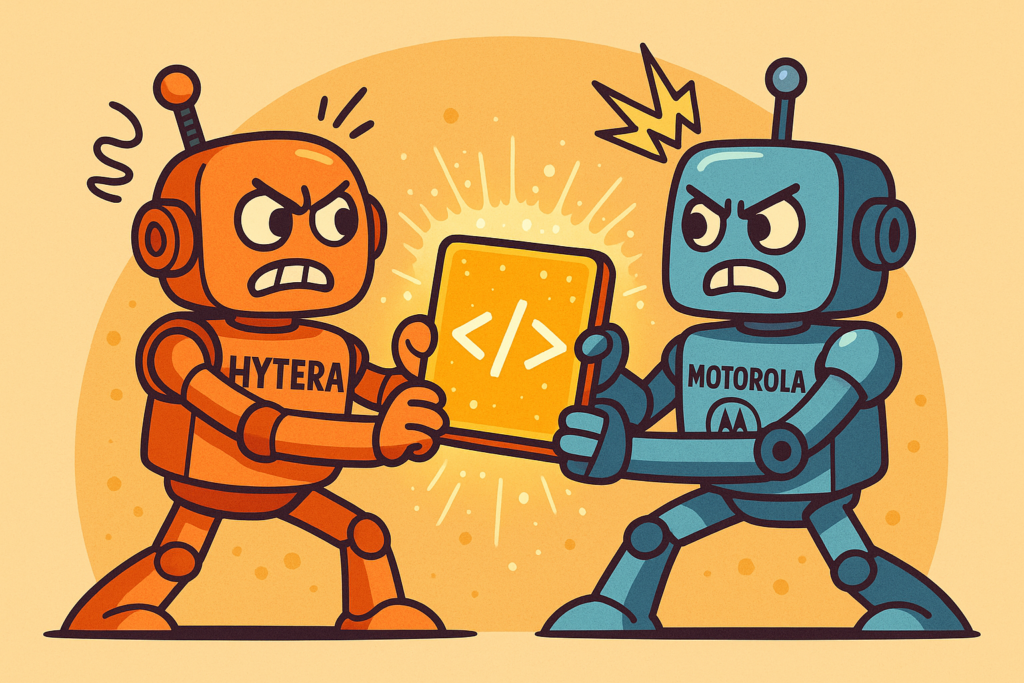
Robot Rumble: Motorola and Hytera Throw Down Over Code

It wasn’t exactly Rock ’Em Sock ’Em Robots, but the recent battle between Motorola Solutions and Hytera Communications was certainly a copyright and tech-world punch-up — with real ramifications for copyright law relating to software.

Motorola accused Hytera of pinching thousands of confidential documents and source code files — the digital DNA of Motorola’s radio communications tech — and using them to turbocharge Hytera’s own products.

The claim was that three Motorola engineers downloaded a treasure trove of materials from their work accounts before hopping over to Hytera in 2008. Motorola was not amused, and sued in both the US and Australia, claiming copyright infringement, trade secret theft, and that it’s just not cricket.

Here’s how it unfolded:

Year Event
2007–2008 Three Motorola engineers leave, allegedly taking source code and confidential documents.
2010s Hytera launches eerily similar digital mobile radios (DMRs) into the market.
2017 Motorola sues Hytera in the US (for trade secret theft and copyright infringement).
2020 A US jury awards Motorola nearly US$765 million.
2024 The US Seventh Circuit Court of Appeals cuts down the damages, ruling copyright law doesn’t stretch to overseas sales.
2022–2024 In Australian proceedings, Motorola wins a Federal Court case finding substantial copying of its software and some patent infringements.

In Australia (Hytera Communications Corporation Ltd v Motorola Solutions Inc [2024] FCAFC 168), the Federal Court was having none of Hytera’s various arguments. It found that Hytera’s software infringed Motorola’s copyrights in six major works and awarded Motorola remedies accordingly. One of Motorola’s patents was also found infringed — though another was knocked out for invalidity.

So, why does this matter for copyright and software?

First up: software source code is absolutely protected by copyright.  Nothing has changed there.

It doesn’t matter if the copying happened sneakily, through engineers quietly/brazenly exporting files out the back door. If your new product looks suspiciously like the old employer’s, and the code similarities are undeniable, you’re probably in trouble.

It’s a breach of copyright in a copyright work to copy all or a substantial part of the copyright work without permission.  What this case does is clarify what “substantial part” means when it comes to software.

Generally, in copyright, the test for whether the copied bit was a “substantial part” of the copyright work is a “qualitative test” – that is, it’s about quality, not quantity.

In a music context, cases such as the famous “Men At Work” case (EMI Songs v Larrikin Music) taught us that it’s how important the copied musical passage was to the whole work and not how lengthy it was (that quirky flute part in “Land Down Under” was held to be a reproduction of an important, but short, part of the melody in “Kookaburra Sits in the Old Gum Tree”).

The Court in that case said substantiality depends mainly on the importance or distinctiveness of the part copied in relation to the original work — even a small musical phrase, if distinctive, could be substantial.

In Hytera, though, the Court made an important distinction.  When it comes to software, it’s not about how functionally important the copied code is. You could copy a piece of code that barely moves the dial commercially — and still infringe. The real test is whether the copied part contains the original intellectual effort and creative expression of the coder.

It’s a subtle shift from cases like Men at Work, where the Court focused on whether the snippet (a melody, in that case) was distinctive or significant to the work overall.

In software land, copyright doesn’t care how useful the copied bit is — it only cares if it was original.

The Court in Hytera, though, was careful when discussing “intellectual effort” not to revert entirely back to the old “sweat of the brow” arguments.

In the old Desktop Marketing Systems v Telstra case (early Federal Court levels) it was held that just collecting and compiling basic data was enough for copyright to apply, because it involved effort to compile it all together – that is, it involved “sweat of the brow.”

But then IceTV v Nine (2009) came along, in which the High Court said No — effort alone is not enough.  It was held that copyright protects original expression — meaning something resulting from independent intellectual effort and some creative choice, not just labour.

In Hytera, the Court was very careful not to slip all the way back into pure “sweat of the brow” thinking – the Court didn’t say that simply writing code or working hard gave rise to copyright protection.  Instead, they said:

  • The copied source code was protected because it reflected original intellectual effort and creative choices — not just functional output.

  • You still need some degree of creative expression — but in software, that creativity can sit in how the code is written, how problems are solved, and the structure of the program — not necessarily in the “importance” of the function itself.

In other words:

  • Not just “I worked hard, therefore copyright.”

  • But “I made creative and original choices, therefore copyright — even if the code serves a functional purpose.”

Copyright Lessons from Hytera

  • Don’t steal code. Seriously. Just don’t – it leaves digital fingerprints everywhere.

  • Copyright protects software structure and content, not just fancy graphics or user interfaces.

  • Judges don’t love “but we changed it a bit” arguments when the starting point was a pile of stolen files.

High Court Appeal?

In early April, Hytera applied to the High Court for special leave to appeal, but in an extra blow to Hytera’s already deflated spirits, the High Court refused to grant leave as their appeal “does not enjoy sufficient prospects of success to warrant the grant of special leave”.  Ouch …

Filed Under: Copyright, IP, Technology Tagged With: Copyright, IP, Technology

April 28, 2025 by Scott Coulthart

How Not to Avoid Copyright Breach

In a podcast earlier this month, pop star Ed Sheeran said that recent copyright disputes have changed how he makes music.

While he has been involved in several copyright disputes where someone has accused him of plagiarising/copying their original music, he says that he has never lost any such claim since 2017, and he puts it down to the fact that he records all of his writing/jam/practice sessions now.

The theory is that if he records the sessions, he has recorded evidence that any music that comes out of the sessions he made up himself and wasn’t a copy of anyone else’s music.

Erm … sorry, Ed – that’s like videoing a road you cross every day to avoid getting hit by a car.  You can still get hit, but now it’ll be on video.

Even if you don’t consciously copy someone else’s music during a session, that doesn’t mean that you haven’t actually done so.  All you’re doing is recording the moment you incorporated their music into something you play during a session.

You see, you can innocently infringe someone else’s copyright.  Any writer/composer will tell you that new music they create, whether in a jam session or otherwise, is always inspired by something – sometimes events, sometimes emotions, and sometimes by music heard recently.  If your music is inspired in part by music you heard recently, it’s not a big jump from there to being in breach of copyright.

The legal test is not a subjective one about whether you intentionally copied someone’s music – the test is an objective one involving what a reasonable person would conclude after considering your music, the other music, the various components of each and whether you had the opportunity to copy the other music (for example, is there evidence that you had previously heard the other music?).

This is not a criticism against recording your practice sessions – that’s always a good thing (especially when something catchy comes out of it – you don’t have the problem then to try to remember later what you played) … but it is not a good way to avoid breach of copyright – it’s simply a way to record it.

Filed Under: Copyright, Entertainment, IP Tagged With: Copyright, Entertainment, IP

  • « Go to Previous Page
  • Go to page 1
  • Interim pages omitted …
  • Go to page 16
  • Go to page 17
  • Go to page 18
  • Go to page 19
  • Go to Next Page »

Primary Sidebar

Recent Posts

  • Unf*cking the Register: IP Australia Accepts “UNFVCK YOURSELF” Trade Mark
  • Firework Fizzles (For Now): The High Court Re-stitches the Katy Perry Trade Mark Battle
  • 🏇 When the Race Stops a Nation — Who Owns the Moment?
  • AI Training in Australia: Why a Mandatory Licence Could Be the Practical Middle Ground
  • AI-Generated Works & Australian Copyright — What IP Owners Need to Know

Archives

  • March 2026 (2)
  • November 2025 (1)
  • October 2025 (14)
  • September 2025 (21)
  • August 2025 (18)
  • July 2025 (16)
  • June 2025 (21)
  • May 2025 (12)
  • April 2025 (4)

Footer

© Scott Coulthart 2025