• Skip to primary navigation
  • Skip to main content
  • Skip to primary sidebar
  • Skip to footer

IPMojo

  • About IP Mojo
  • About Scott Coulthart
  • CONTACT
BOOK AN APPOINTMENT

Entertainment

March 12, 2026 by Scott Coulthart

Firework Fizzles (For Now): The High Court Re-stitches the Katy Perry Trade Mark Battle
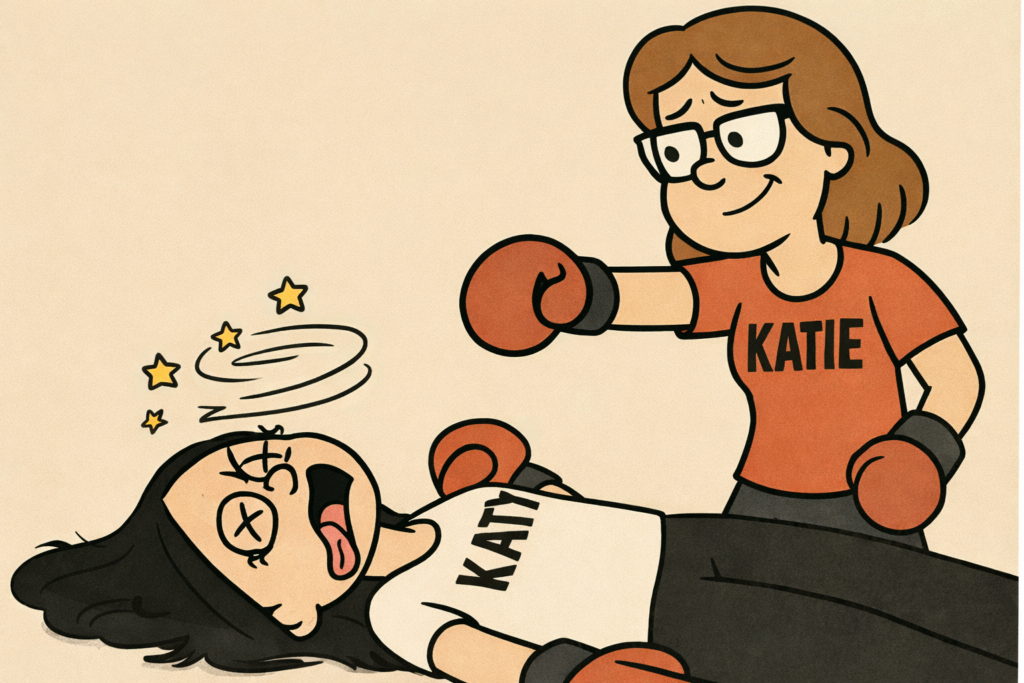
The long-running trade mark dispute between Australian designer Katie Taylor (born Katie Perry) and global pop star Katy Perry (Katheryn Hudson) has now reached the High Court of Australia — and the result is a dramatic twist.

In Taylor v Killer Queen LLC [2026] HCA 5, the High Court has allowed Taylor’s appeal, setting aside the Full Federal Court’s decision that had ordered cancellation of her “KATIE PERRY” clothing trade mark.

The matter now returns to the Full Court to determine the remaining issues — meaning the fight isn’t quite over yet.

But the High Court’s reasoning significantly reshapes how courts should approach reputation-based cancellation and trade mark confusion involving celebrities.

Let’s unpack it.

🎤 The Background: Pop Star vs Fashion Label

This dispute has been simmering for more than 15 years.

In 2007–2008:

  • Australian designer Katie Taylor launches a clothing brand using her birth name KATIE PERRY.

  • She applies to register the word mark for clothing in September 2008.

Meanwhile:

  • US singer Katy Perry is exploding globally with hits like I Kissed a Girl.

  • Her fame reaches Australia during the same period.

The problem?  The names are aurally identical and visually very close.

Taylor’s mark was eventually registered in 2009, and for years the two brands co-existed uneasily.

Then in 2019, the singer’s companies launched proceedings seeking to cancel the registration.

⚖️ What Happened in the Courts

The litigation has already taken several turns.

Federal Court (trial)

The trial judge:

  • found infringement by Perry-related merchandise sellers; but

  • refused to cancel Taylor’s trade mark.

The key finding was that, although the singer had a reputation in Australia in music and entertainment, she did not have a reputation in clothing at the priority date.

Full Federal Court

On appeal, the Full Court reversed that result, holding that:

  • Katy Perry’s reputation as a global pop star was sufficient;

  • consumers would expect pop stars to sell merchandise like clothing; and

  • the marks were so similar that confusion was likely.

Result: Taylor’s trade mark was ordered cancelled.

👑 The High Court Decision

The High Court has now allowed Taylor’s appeal and set aside that cancellation order.

The Court split in its reasoning, but the majority rejected key aspects of the Full Court’s approach.

The case has been remitted to the Full Federal Court to reconsider outstanding issues.

In practical terms, Taylor’s trade mark survives — at least for now.

The appeal centred on three important provisions of the Trade Marks Act 1995 (Cth):

  • s 60 — opposition based on reputation

  • s 88(2)(a) — cancellation based on grounds that could have opposed registration

  • s 88(2)(c) — cancellation where current use would cause confusion

  • s 89 — discretion not to cancel

The decision digs deeply into how reputation and confusion should actually be assessed.

1️⃣ Reputation Must Be Carefully Identified

The Court confirmed that s 60 requires reputation in a trade mark, not merely general fame.

“Reputation” in this context means recognition of the mark by the public, reflecting its “credit, image and values”. 

The crucial question, though,  is “Reputation for what?”.

In this case, the singer’s mark clearly had reputation in music and entertainment, but there was debate about whether that reputation extended to clothing.

The High Court emphasised that reputation does not automatically spill across industries simply because celebrities often expand their brands.

2️⃣ Confusion Must Arise Because of the Reputation

Another key point was that the likelihood of deception must arise because of the prior mark’s reputation, not merely because the marks look similar.

In other words, similarity alone is not enough — the reputation must drive the confusion.

The Court reiterated the classic test – would a reasonable number of people wonder if a trade connection exists?

This inquiry is assessed by comparing actual reputation of the earlier mark with notional normal and fair use of the challenged mark.

3️⃣ Notional Use Still Matters

A key trade mark principle resurfaced strongly, namely that courts assess how the registered mark could be used, not just how it actually has been used.

That means asking what legitimate uses could the trade mark owner make of the mark?

This concept of “notional normal and fair use” has long been part of Australian trade mark law, but the High Court’s analysis reinforces its importance.

4️⃣ Section 89 Discretion Remains Narrow

Another major issue was the discretion not to cancel a mark under s 89.

The Full Court had effectively ruled that Taylor’s act of applying for the trade mark — knowing of the singer’s fame — was enough to defeat that discretion.

The High Court’s reasoning suggests that approach may have been too rigid, holding instead that the question is whether the ground for cancellation arose through the registered owner’s “act or fault”.

That issue will now be reconsidered when the case returns to the Full Court.

🧵 Why This Case Matters

This decision will have ripple effects far beyond celebrity disputes.

It highlights several key principles:

  • Fame ≠ automatic trade mark dominance – A celebrity’s reputation does not automatically block registrations in unrelated markets.
  • Reputation must be analysed carefully – Courts must identify what goods or services the reputation actually relates to.
  • Confusion must flow from reputation – Section 60 is not simply a deceptive similarity test.
  • Cancellation powers are not automatic – Even where confusion might arise, discretionary factors still matter.

🎬 Final Stitch

At one level, this case is a quirky battle between two women with nearly identical names.

At another, it raises profound questions about how trade mark law treats celebrity brands.

Should global fame give artists a shadow monopoly across merchandising categories?

Or should trade mark rights remain tied to actual commercial use and reputation?

The High Court hasn’t ended the fight — but it has reshaped the legal framework in which it will be decided.

For now, at least, Katie Perry the designer still has her label.

Filed Under: Entertainment, IP, Trade Marks, Uncategorized Tagged With: Entertainment, IP, Trade Marks

November 4, 2025 by Scott Coulthart

🏇 When the Race Stops a Nation — Who Owns the Moment?

IP and brand lessons from Melbourne Cup Day

Every year on the first Tuesday in November, Australia stops for a horse race — and an extraordinary showcase of intellectual property.

Behind the glamour of Flemington, the fascinators and the flutter, lies a multi-layered web of IP rights: trade marks, designs, broadcast rights, sponsorships, licensing deals, and image rights that turn the Cup into one of the country’s most valuable event brands.

1. The Cup as a brand

The Victoria Racing Club (VRC) owns an extensive portfolio of trade marks covering “Melbourne Cup”, “The Race That Stops a Nation”, and the stylised gold trophy design. Those marks underpin everything from official merchandise to broadcast and hospitality rights.

For the VRC, it’s not just a horse race — it’s a global brand, protected by careful registration, licensing and enforcement. The lesson for other major events? File early, file broad, and police consistently.

2. Who owns the horse’s name?

When a horse becomes famous — Think Winx, Black Caviar, Makybe Diva — the name itself becomes valuable IP. Owners often move quickly to register trade marks covering racing merchandise, breeding rights, and promotional uses.

But racehorse naming rules also complicate matters: under Racing Australia’s rules, a horse’s name is licensed rather than owned, and certain names (of champions, or those with cultural significance) are permanently retired. That means an owner’s branding ambitions must navigate both trade mark law and the racing registrar’s strictures.

3. Passing off and false endorsement

Every Cup season brings a flurry of betting apps, sweep generators, and corporate promotions trying to ride the coattails of the “Cup” brand. Some risk drifting into misleading or infringing territory — using “Melbourne Cup” or the trophy image without authorisation.

It’s a classic passing-off risk: implying a connection or endorsement that doesn’t exist. The same principle applies beyond racing — whether your brand is invoking a festival, a celebrity, or a social movement, the question is always: does your use suggest official connection?

4. Fashions on the field — designs and branding

Even the fashion stakes come with IP issues. Designers rely on copyright, design registration, and branding to protect original pieces and accessories that debut trackside. Increasingly, brands run their own protected pop-ups and virtual events — blurring physical and digital rights.

5. Modern twists: influencers and digital IP

Today, Cup-day marketing spills across Instagram and TikTok. Influencers tag official partners, brands push instant content, and deepfakes and AI imagery are starting to creep in. For rights-holders, monitoring unauthorised digital use (and generative reproductions) has become the new frontier of event IP protection.

Take-away for brands and advisers

  • Register broadly: secure word, logo and shape marks early — even for event slogans.

  • Control use: structure sponsorships, broadcast and influencer agreements with precise IP clauses.

  • Monitor aggressively: unauthorised “association” can dilute event value fast.

  • Think digital: protect imagery, NFTs, and virtual activations just as you would physical goods.

The Melbourne Cup may stop the nation — but the IP behind it never sleeps.

Filed Under: Entertainment, IP, Trade Marks Tagged With: Entertainment, IP, Trade Marks

August 15, 2025 by Scott Coulthart

Site-Blocking at Scale: Roadshow v Telstra 2025 and the Machinery of s 115A

Roadshow Films Pty Limited v Telstra Limited [2025] FCA 744 marks another brick in the ever-growing wall of Australian site-blocking jurisprudence. The decision adds little doctrinal spice but delivers a strong dose of enforcement pragmatism — and plenty to reflect on.

🎬 The Backstory

In this latest chapter of the Roadshow saga, rights-holders — including Disney, Netflix, Warner Bros., Paramount and others — sought injunctions under s 115A of the Copyright Act to block dozens of offshore streaming sites serving up pirated films to Australian users. The targets included notorious offenders like Hianime, Soap2Day, 123Movies, and HydraHD — many already well known to regular visitors of the Federal Court’s website.

📡 The ISPs: Here We Go Again

The respondents — a who’s who of Australia’s internet service providers (Telstra, Optus, TPG, Vodafone, Vocus, and Aussie Broadband) — all filed submitting appearances. They didn’t contest the application and were ordered to implement DNS, IP, and/or URL blocking within 15 business days of service. Compliance costs were awarded at $50 per domain, continuing the usual practice.

🧾 The Legal Machinery

Justice Younan applied the now-settled framework from the earlier Roadshow decisions. Key points:

  • The Court relied on deemed admissions and hearsay waivers (under s 190 of the Evidence Act) to accept that copyright subsisted, was owned or exclusively licensed to the applicants, and was being infringed.

  • Reasonable efforts had been made to notify the site operators, who unsurprisingly didn’t show.

  • The purpose and effect of the sites was plainly to infringe or facilitate infringement: free access to recent films, indexed and monetised by ads.

📈 Expansion Orders and Continuity Clauses

The orders include mechanisms for:

  • Rolling additions of new domains/IPs via solicitor certificates and no-objection notices;

  • Applications to extend the block after the initial 3-year lifespan expires;

  • Rights of affected site owners to apply to vary or discharge the order.

🧠 So What?

This case adds to a growing body of precedent that renders s 115A injunctions almost administrative when uncontested. The Federal Court has effectively created a template — one that large rights-holders can now run through with minimal friction.

But there are questions here too:

  • Does this model amount to efficient enforcement, or a piecemeal arms race?

  • Should there be more judicial scrutiny — especially where evidence is largely hearsay or paralegal-driven?

  • Is blocking access via ISPs still a meaningful remedy in a world of VPNs and mirror sites?

📌 Either way, the case underscores how s 115A — once a bold legislative experiment — is now part of the copyright enforcement machinery. It may not be glamorous, but it’s getting the job done.

Filed Under: Copyright, Entertainment, IP Tagged With: Copyright, Entertainment, IP

August 11, 2025 by Scott Coulthart

Never Get Busted! — Principal Director Dispute Stops the Projectors Rolling

The Federal Court has issued an injunction two days before the Melbourne International Film Festival (MIFF) in relation to the credits of a documentary called Never Get Busted! after one of its co-directors claimed the other director was busted crediting himself as “Principal Director”.
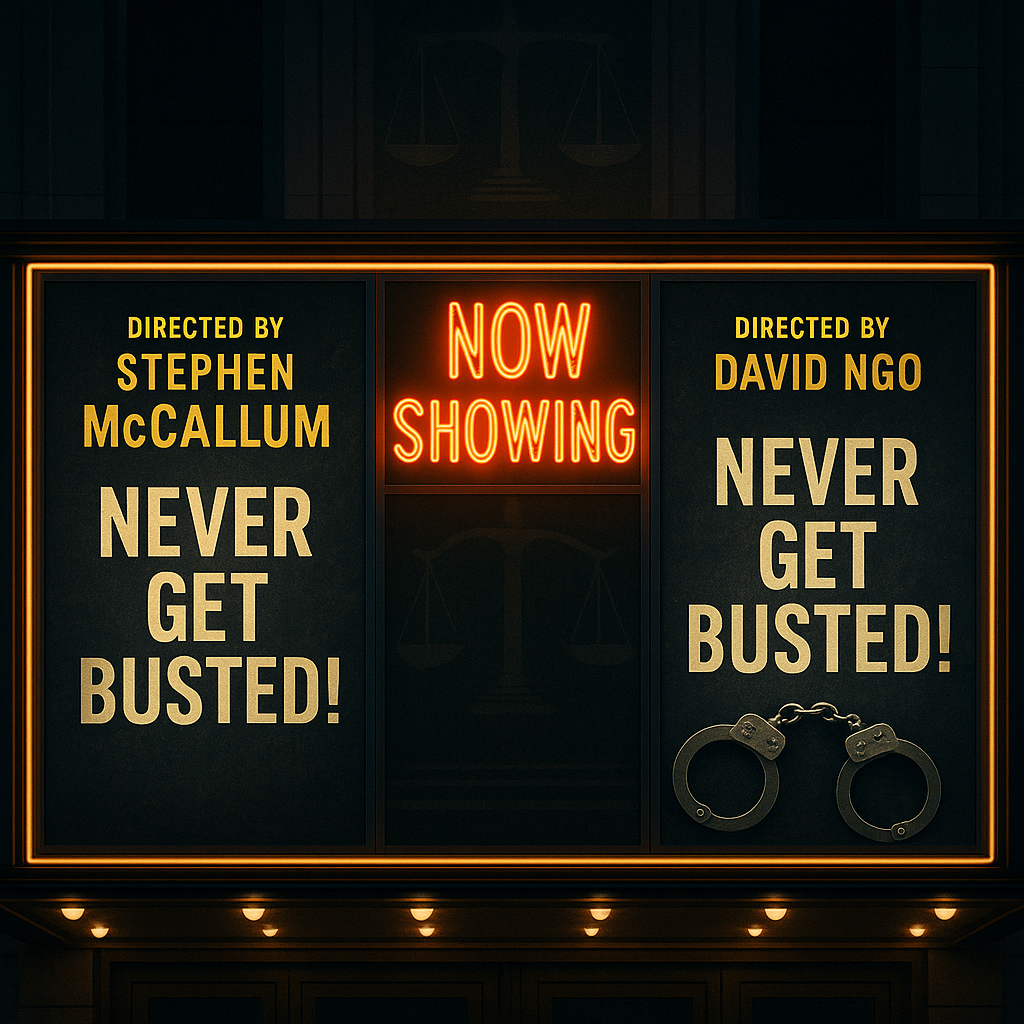
The fight for “Principal Director”

Stephen McCallum and David Ngo both directed the documentary, but McCallum claimed he was the Principal Director under both his contract and the Copyright Act 1968 (Cth).

That distinction matters. Section 191 says that where there’s more than one director, “director” means principal director for moral rights purposes. Being named principal director can influence reputation, career progression, and eligibility for awards.

Ngo accepted McCallum was a director, but said he (Ngo) was the principal director — especially after McCallum allegedly stepped back from key phases of production.

Moral rights + misleading conduct

McCallum alleged:

  • Infringement of his moral rights — failure to attribute him as principal director and false attribution of Ngo as principal director (ss 189, 191, 195AW).

  • Misleading and deceptive conduct under the Australian Consumer Law (ACL s 18) — particularly in promotional materials suggesting Ngo alone “helmed” the film.

The respondents countered that McCallum had waived or consented to infringements via a contractual clause (cl 6.2) and that the current festival credits, listing both men as “Directors”, were enough.

Why credit order matters

Industry evidence showed that:

  • The phrase “Directed by” — and the order of names — signals who is principal director.

  • The person listed last in opening credits (or first in closing credits) is usually the principal director.

  • Festival program notes, Q&A invitations, and even website blurbs shape perception within the industry, not just for audiences.

Here, McCallum’s name came second to Ngo in credits and promotional materials, with Ngo described as “helming” the project. The Court found this created a real risk of conveying Ngo as sole principal director.

The injunction

Justice Shariff found a serious question to be tried and that the balance of convenience favoured McCallum. The injunction stopped the screening and promotion unless:

  • The credits read “Directed by Stephen McCallum” and did not say “Directed by” for Ngo; or

  • Promotional materials gave McCallum the principal director attribution.

McCallum’s alternative — stating the credits were “the subject of court proceedings” — was rejected as commercially riskier.

Why it matters

This isn’t just about ego or font order. It’s about:

  • The legal and reputational value of creative credits.

  • How moral rights, contracts, and the ACL can collide.

  • How quickly these disputes can boil over when a premiere’s at stake.

💡 IP Mojo Tips:

  • Lock it in — Nail down exactly how you’ll be credited in your contract, including the exact wording and where it appears.

  • Think beyond the film — Festival programs, Q&A panels, and press releases are part of your “attribution ecosystem”.

  • Watch the waivers — A broad moral rights consent might not save the other side if it clashes with specific credit clauses.

The sequel? The full trial is set for September 2025. Pass the popcorn.

Filed Under: Contracts, Entertainment, Film Law, IP Tagged With: Contracts, Entertainment, Film Law, IP

July 9, 2025 by Scott Coulthart

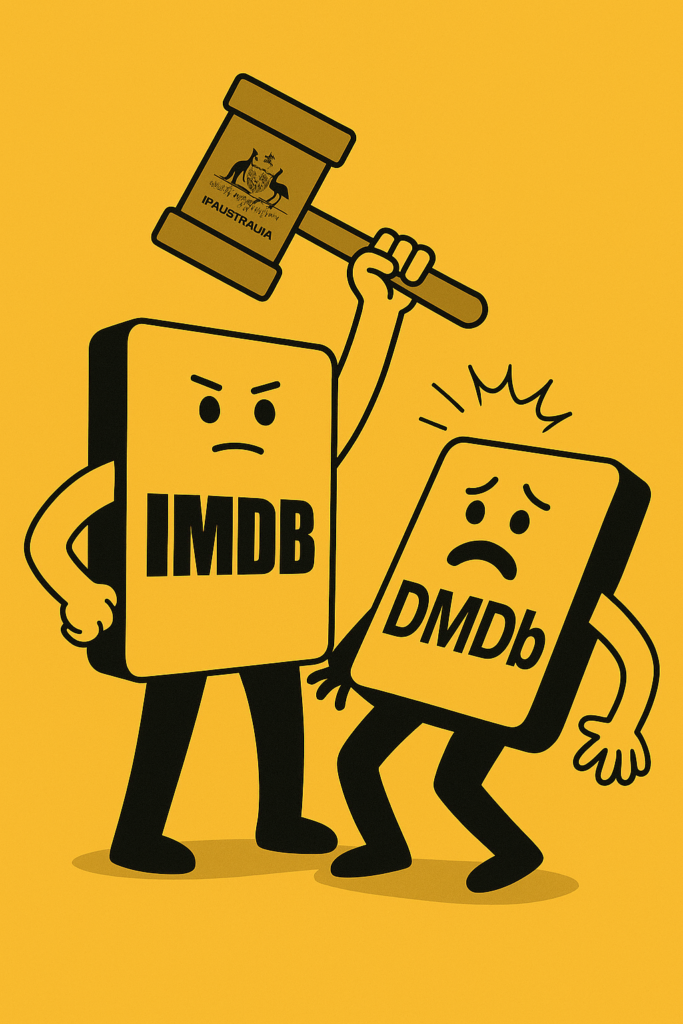
IMDb v DMDb: One Letter’s Difference Not Enough

Zumedia Inc’s attempt to register DMDb as a trade mark in Australia fell flat—thanks to its awkward proximity to a far more famous acronym: IMDb.

Zumedia, a Canadian company behind a digital media platform called “Digital Media Database,” applied to extend its international trade mark registration for DMDb into Australia. But IMDb, the internet’s go-to entertainment database, wasn’t about to let that slide. Backed by nearly 30 years of global use and widespread recognition in Australia, IMDb opposed the extension under section 60 of the Trade Marks Act 1995.

IP Australia sided with IMDb. Despite the difference in the first letter, Delegate Tracey Berger found the marks visually and aurally similar, especially given the overlapping services—both related to searchable databases of entertainment content. Australian users, she held, could easily assume DMDb was affiliated with or endorsed by IMDb.

Zumedia tried to argue that DMDb was a unique acronym and that “Db” simply stood for “database.” Ironically, that only strengthened the opposition’s case: as the Delegate pointed out, consumers often remember brands imperfectly. The shared “-MDb” element was enough to trigger a mistaken belief in a connection.

She also referenced prior cases—including AAMI and Tivo v Vivo—to reinforce the point: when a well-known mark has a strong reputation in the same field, even small differences won’t eliminate the risk of confusion.

The outcome?  Extension of protection refused. Costs awarded against Zumedia.

🎬 IP Mojo Takeaway: If your brand sits one letter away from an iconic name in the same industry, don’t count on slipping through. Trade mark law doesn’t look kindly on near-misses that come too close to the main act.


Filed Under: Entertainment, IP, Trade Marks Tagged With: Entertainment, IP, Trade Marks

July 4, 2025 by Scott Coulthart

Perry v Perry – Round 3 in the High Court

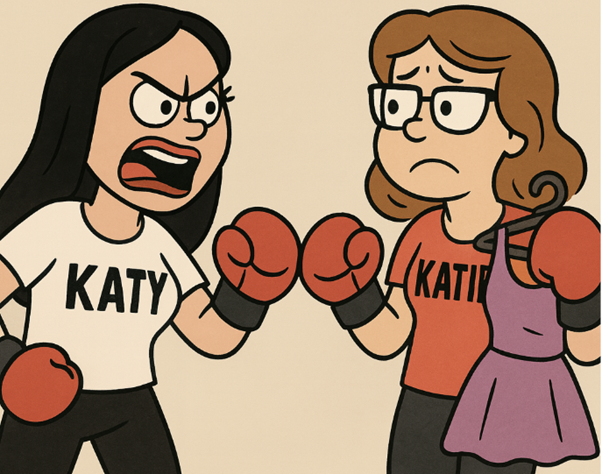
The long-running IP clash between Australian designer Katie Taylor (aka Katie Perry) and US popstar Katheryn Hudson (aka Katy Perry) has now reached the High Court. Both sides have filed their submissions—and the gloves are well and truly off.

Let’s unpack the arguments.


🎤 The Trade Mark at War

At the heart of the dispute is Taylor’s registered mark KATIE PERRY for clothing, registered in 2009. Hudson’s team argues that it should never have been allowed to stay on the register—because of her own fame under the name Katy Perry, and the likelihood of confusion in the public mind.

This fight has already been through:

  • The Federal Court (where Taylor won on infringement, but the respondents failed to cancel her trade mark),

  • and the Full Federal Court (which overturned the trial judge and ordered cancellation under ss 60 and 88(2)(c)).

Now, Taylor’s appeal to the High Court gives us an opportunity to see how the highest court will treat the tricky interplay between reputation, confusion, and celebrity brand extension.


⚖️ Key Appeal Issues

The submissions squarely raise three points of trade mark law importance:

  1. Reputation Must Be in a Trade Mark, Not Just a Name
    Taylor argues (citing Self Care IP) that reputation in a person isn’t enough—section 60 requires a reputation in a trade mark used to distinguish goods or services. The respondents say that “Katy Perry” was functioning as a mark in connection with music and entertainment—even if not for clothes—by the priority date.

  2. Deceptive Similarity ≠ Confusion from Reputation
    Taylor says the Full Court wrongly blurred section 60 with the s 10 concept of deceptive similarity, using “imperfect recollection” logic that belongs elsewhere. She maintains that just because the names look similar doesn’t mean there’s a s 60 ground for cancellation unless confusion arises because of the earlier mark’s reputation.

  3. Discretion Under s 89: Who’s at Fault?
    The Full Court held that Taylor’s act of applying for the mark—with knowledge of Katy Perry’s fame—was enough to defeat the saving provision in s 89. Taylor argues this turns s 89 into a dead letter. Is the act of registration itself always a fault? If so, what’s left for discretion to do?


👑 Celebrity Brands and Trade Mark Realpolitik

The respondents press the idea that by 2008, there was an established trend of pop stars launching fashion lines—and that any member of the public hearing “KATIE PERRY” on a swing tag might assume a connection with the singer. They argue:

  • Reputation in entertainment was enough to ground confusion over clothes;

  • The law shouldn’t insist on technical “use as a trade mark” when real-world fame does the work.

Taylor says: Not so fast. Reputation should attach only to actual marks used to distinguish goods. And if the singer hadn’t sold clothes in Australia before the priority date—let alone registered a mark for clothing—why should she get a monopoly over a local designer’s name?


🧵 Threads to Watch

This appeal gives the High Court a chance to clarify several issues that matter beyond this case:

  • What counts as reputation in a “trade mark”? Is global fame enough?

  • Does fame create a shadow monopoly over unrelated goods where the celebrity hasn’t yet traded?

  • When is confusion “likely”? Must it be tied to reputation for the same goods?

  • Is s 89 still alive? Or does knowledge at the time of filing always kill it?


🪙 Final Stitch

This is a rare IP battle where both sides have established, legitimate reputations—and where delay, co-existence efforts, and evolving fame all muddy the waters. Whatever the High Court decides, it’s likely to have ripple effects across celebrity branding, merchandising strategy, and the interpretation of section 60.

🧵 Stay tuned.

Filed Under: Entertainment, IP, Trade Marks Tagged With: Entertainment, IP, Trade Marks

  • Go to page 1
  • Go to page 2
  • Go to Next Page »

Primary Sidebar

Recent Posts

  • Unf*cking the Register: IP Australia Accepts “UNFVCK YOURSELF” Trade Mark
  • Firework Fizzles (For Now): The High Court Re-stitches the Katy Perry Trade Mark Battle
  • 🏇 When the Race Stops a Nation — Who Owns the Moment?
  • AI Training in Australia: Why a Mandatory Licence Could Be the Practical Middle Ground
  • AI-Generated Works & Australian Copyright — What IP Owners Need to Know

Archives

  • March 2026 (2)
  • November 2025 (1)
  • October 2025 (14)
  • September 2025 (21)
  • August 2025 (18)
  • July 2025 (16)
  • June 2025 (21)
  • May 2025 (12)
  • April 2025 (4)

Footer

© Scott Coulthart 2025