Whose Work Is It Anyway? The Remix War, AI, Coffee Plungers and Swimsuits
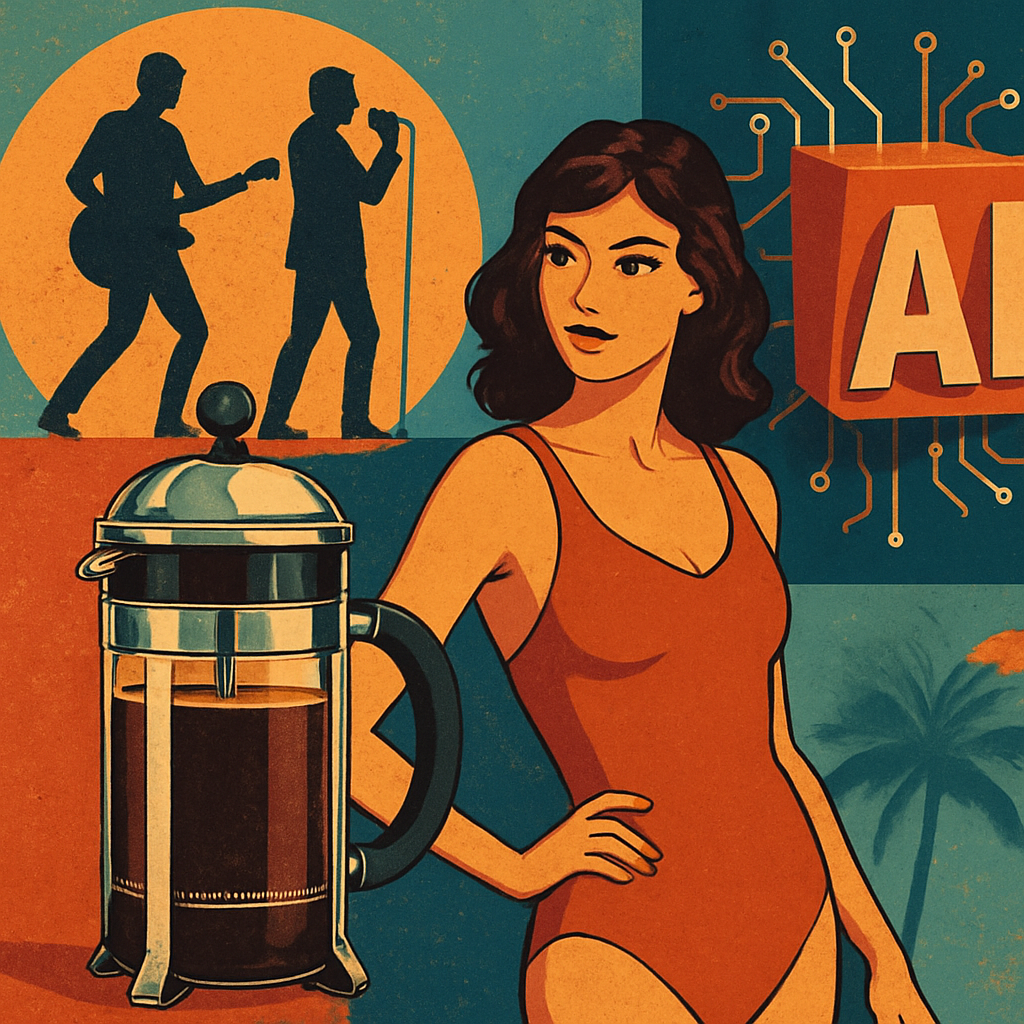 From Elton John to anonymous meme-makers, a battle is raging over what it means to be “creative” — and whether it starts with permission.
Two stories made waves in copyright circles last week:
-
In the UK, Sir Elton John, Sir Paul McCartney and other musical heavyweights called for stronger rules to stop AI from “scraping” their songs without a licence.
-
In India, news agency ANI drew criticism for aggressively issuing YouTube copyright claims — even for sub-10 second clips — triggering takedown threats against creators.
At first glance, these might seem worlds apart. But they highlight the same question:
At what point does using someone else’s work become exploitation, not inspiration?
And who decides?
Creators vs Reusers: Two Sides of the Copyright Culture Clash
On one side: Creators — musicians, writers, filmmakers, photographers — frustrated by tech platforms and algorithms ingesting their work without permission. Whether it’s AI training data or news footage embedded in political commentary, their message is the same:
“You’re building on our backs. Pay up.”
On the other side: Remixers, meme-makers, educators, and critics argue that strict copyright regimes chill creativity. “How can we critique culture,” they ask, “if we’re not allowed to reference it?”
This isn’t new — hip hop, collage art, satire, and even pop music are full of samples and nods. But AI has industrialised the scale of reuse. It doesn’t borrow one beat or a single shot. It eats the entire catalogue — then spits out something “new.”
So what counts as originality anymore?
Australian Lens: Seafolly, Bodum, and the Meaning of “Original”
Seafolly v Madden [2012] FCA 1346
In this high-profile swimwear spat, designer Leah Madden accused Seafolly of copying her designs. She posted comparison images on social media implying that Seafolly had engaged in plagiarism. Seafolly sued for misleading and deceptive conduct under ss 52 and 53 of the Trade Practices Act 1974 (predecessors to s18 of the Australian Consumer Law – which had by then commenced but the relevant conduct being sued for took place before it had commenced).
The Federal Court found that Madden’s claims were not only misleading but also unsubstantiated, because the design similarities were not the result of actual copying. The case reinforced that:
-
Independent creation is a valid defence, even if the resulting works are similar
-
Superficial resemblance isn’t enough — there must be a causal connection
It’s a reminder that derivation must be substantial and material, not speculative or assumed.
Bodum v DKSH [2011] FCAFC 98
This case involved Bodum’s iconic French press coffee plunger — the Chambord — and whether a rival product sold by DKSH under the “Euroline” brand misled consumers or passed off Bodum’s get-up as its own.
Bodum alleged misleading or deceptive conduct and passing off, based not on name or logo, but on the visual appearance of the product: a clear glass beaker, metal band, and distinctive handles, which had come to be strongly associated with Bodum.
At trial, the Federal Court rejected Bodum’s claims. But on appeal, the Full Federal Court reversed that decision, holding that:
-
Bodum had a substantial reputation in the get-up alone;
-
The Euroline plunger was highly similar in appearance; and
-
DKSH’s failure to adequately differentiate its product through branding or design gave rise to a misleading impression.
Both passing off and misleading/deceptive conduct (also under the old s52) were found. The Court emphasised that reputation in shape and design can be enough — and differentiation must be meaningful, not tokenistic.
The AI Angle: Who Trains Whom?
AI tools like ChatGPT, Midjourney, and Suno don’t just copy works. They learn patterns from thousands of inputs. But in doing so, they arguably absorb creative expression — chord progressions, phrasing, brushstroke styles — and then make new outputs in that same vein.
AI developers claim this is fair use or transformative. Artists argue it’s a form of invisible appropriation — no different from copying and tweaking a painting, but with zero attribution or compensation.
It’s the Seafolly and Bodum problem, scaled up: if AI’s “original” work was trained on 10,000 human ones, is it really original? Or just a remix with plausible deniability?
The Bottom Line
Copyright law is meant to balance:
-
Encouraging creativity
-
Rewarding labour
-
Allowing critique and cultural dialogue
But that balance is breaking under the weight of machine learning models and automated copyright bots. As Seafolly and Bodum show, the law still values intention, process, and context — not just resemblance.
Yet in a world of remix and AI, intention is opaque, and process is synthetic.
So where do we draw the line?
 What happens when your new brand smells a little too much like the towels next door?
 Not a
Not a