Where in the World Is Patent Infringement?
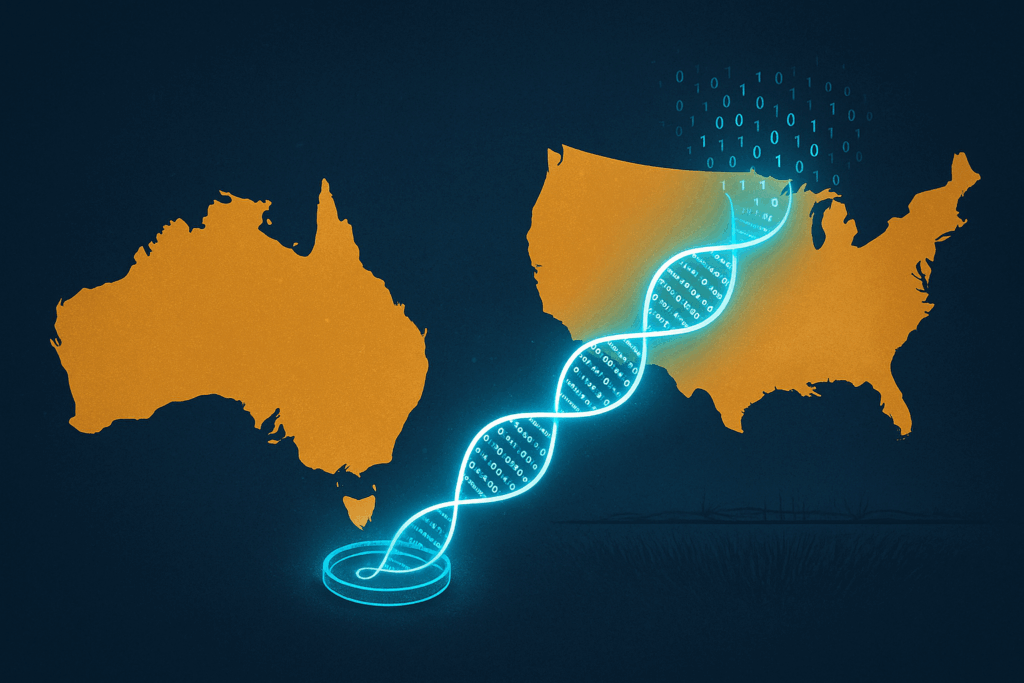 Scidera v MLA and the Offshore Method Problem
What happens when half your invention lives in the cloud — or, worse, on another continent?
That’s the question Rofe J has just (on 10 October 2025) refused to shut down in Scidera, Inc v Meat and Livestock Australia Ltd (No 2) [2025] FCA 1236.
The decision keeps alive a fascinating issue: can you infringe an Australian method patent when some of the steps happen overseas?
The background: cows, code and cross-border science
Scidera holds a patent for a method of identifying genetic traits in cattle by analysing single-nucleotide polymorphisms (SNPs) — essentially, genetic markers associated with desirable characteristics like feed efficiency or milk yield.
Zoetis, a major player in animal genetics, collects biological samples from Australian cattle but ships them to its US affiliate for lab testing on Illumina “SNP Chips”. The raw genetic data are then transmitted back to Australia, where they’re integrated into local systems to produce breeding-value reports for Australian farmers.
Scidera sued, alleging that this end-to-end process uses its patented method in Australia, even though the “wet-lab” work is performed offshore.
Zoetis’s strike-out strategy
Zoetis sought summary dismissal of all infringement claims, arguing that:
-
All essential integers of the claimed method occur in the US — specifically the physical SNP testing — so nothing is “used” in the patent area as required by s 13 of the Patents Act 1990 (Cth); and
-
Allowing an “in-substance” or “partial” use theory would contradict the territorial limits of Australian patents.
If one step happens in Missouri, they said, there’s simply no infringement in Mudgee.
Scidera’s reply: the trait inference matters
Scidera countered that the patent is not limited to laboratory steps. The act of identifying or inferring the trait — which occurs when Australian data are processed into EBV and ABV reports — is part of the claimed method itself.
On that view, the relevant exploitation occurs in Australia, even if some earlier testing work is done abroad. Scidera also invoked UK authority such as Menashe v William Hill and Illumina v Premaitha, where courts adopted an “in-substance” approach to cross-border method claims.
The Court: too novel for summary execution
Rofe J agreed that Zoetis’s application raised a novel question of law never before determined in Australia:
“Whether all the essential integers of a claimed method or process must be performed within the patent area for there to be infringement of said method or process claim that does not result in a product.”
Her Honour wasn’t persuaded that Zoetis’s narrow, “all-steps-in-Australia” construction was obviously correct. Citing Beach J’s earlier reasoning in Meat & Livestock Australia v Cargill Inc (2018) 129 IPR 278, Rofe J noted that the patent claimed “a method for identifying (or inferring) a trait” — not merely the physical act of testing DNA.
Because the alleged infringing process also included domestic analysis and reporting steps, and because claim construction and common-general-knowledge issues required expert evidence, summary dismissal was inappropriate.
Zoetis’s application was dismissed with costs.
The legal heartbeat: territoriality vs technology
Section 13 of the Patents Act grants the patentee the exclusive right to “exploit the invention” within the patent area — Australia. For product claims, that’s simple: you make or sell a thing here.
But for method claims, exploitation means using the method. When the method’s steps span jurisdictions — as in distributed computing, AI pipelines, or biotech testing — where exactly does “use” occur?
Zoetis urged a hard territorial rule: unless every essential step happens in Australia, there’s no infringement.
Scidera urged a functional test: if, in substance, the method is put into effect here, that’s enough.
Rofe J didn’t decide between them — but by letting the case proceed, she signalled that Australian law may yet evolve beyond the rigid “all integers here” rule.
Why it matters
This skirmish goes far beyond cattle genotyping. It has implications for:
-
Cloud computing and AI – where model training or data processing occurs overseas.
-
Medical diagnostics – where patient samples are analysed offshore, but reports are issued locally.
-
Software as a Service – where code execution crosses borders invisibly.
If the Court ultimately accepts Scidera’s reasoning, offshoring one step won’t guarantee safety from infringement — especially where the commercial benefit and control remain in Australia.
💡 IP Mojo Take
Cross-border collaboration is the new normal, but patent boundaries still cling to old-world geography.
Scidera v MLA may become Australia’s test case for digital and distributed inventions, forcing courts to define where a “method” actually happens when its neurons fire on different sides of the planet.
The takeaway for innovators and counsel:
-
Map your process flow against territorial rights, not just claim language.
-
Offshoring may reduce cost but not always risk.
-
And when a patent claim uses the word “comprising”, expect the court to look at the whole method, not just the bit that happens in the lab.