• Skip to primary navigation
  • Skip to main content
  • Skip to primary sidebar
  • Skip to footer

IPMojo

  • About IP Mojo
  • About Scott Coulthart
  • CONTACT
BOOK AN APPOINTMENT

Scott Coulthart

August 20, 2025 by Scott Coulthart

Copy That, Part 4 – Copyright Duration and the Public Domain

Nothing lasts forever—not even copyright.

In Australia, copyright protection is generous, but it isn’t permanent. Once it expires, the work enters the public domain, where anyone can use it freely without permission or payment. For creators, this means a valuable asset eventually becomes a shared cultural resource. For users, it’s an open invitation to repurpose, remix, and reimagine.


How long does copyright last?

It depends on the type of work:

  • Literary, dramatic, musical, and artistic works: Life of the creator plus 70 years.

  • Films and sound recordings: Generally 70 years from the year of first publication.

  • Broadcasts: 50 years from the year of broadcast.

  • Published editions: 25 years from first publication (protects the typographical arrangement, not the content).


Why the long tail?

The “life + 70 years” rule aligns Australia with most of its major trading partners. The idea is that copyright rewards creators and their estates for decades after creation—often long enough to benefit children and grandchildren—while ensuring that, eventually, the work joins the public’s shared heritage.


The public domain: free, but not always simple

When a work falls into the public domain, you can:

  • Copy, adapt, and distribute it without permission

  • Use it in new creations (films, books, merchandise, etc.)

  • Monetise it without paying royalties

But be careful:

  • New editions, translations, or adaptations of a public domain work can have their own copyright.

  • Moral rights still apply—meaning you may still need to credit the original creator or avoid derogatory treatment.

  • Other rights (like trade marks or cultural heritage protections) can limit how you use older works.


IP Mojo tip: double-check before you dive in

Don’t assume a work is in the public domain just because it’s “old” or freely available online. Confirm the date of creation and publication, and check whether there have been later editions or modifications that might still be protected.

Please note images you find in Google Images or that pop up in your searches irrespective of the search engine you use, are generally not in the public domain and may well be protected by copyright.  That should be your assumption until proven otherwise – don’t assume it’s public domain … find out first!


Next up in our Copy That series:
Part 5 – Exceptions and Limitations: Fair Dealing in Australia
Because yes, there are times you can use someone else’s work without asking first—but they’re narrower than you might think.

Filed Under: Copyright, Copyright Series, IP Tagged With: Copyright, Copyright Series Part 4, IP

August 19, 2025 by Scott Coulthart

Not So Fast, Wingman: Why the Federal Court Said No to a “Teaming Agreement”

Cirrus Real Time Processing Systems Pty Ltd v Jet Aviation Australia Pty Ltd (formerly Hawker Pacific Pty Ltd) [2025] FCAFC 85

When is a deal not a deal? When it’s a teaming arrangement built on a handshake, a hopeful email chain, and a quotation that looks more like a wishlist than a contract.

The Full Court has dismissed an appeal by software supplier Cirrus, who claimed that Jet Aviation (formerly Hawker Pacific) was contractually bound to subcontract Cirrus if it won a lucrative New Zealand Defence Force (NZDF) tender. It didn’t help that the “agreement” was cloaked in contingency, caveats, and future negotiation.

Here’s what happened — and what it means for anyone navigating teaming deals or tender arrangements in the tech or defence space.


🛩 The Backstory: Simulations, Sensors and Soft Promises

In 2016, Jet Aviation was preparing a tender response to the NZDF to provide airborne training systems. It needed software to simulate and display mission data — and turned to Cirrus, developer of a system called ACOTS.

Over several years, Cirrus and Jet Aviation had exchanged emails, draft scopes of work, and multiple versions of quotes. In the final stages of the bid, Cirrus provided a detailed “Version 4 Quotation” (V4Q) and authorised Jet to incorporate it into its tender — but only on condition that Jet would subcontract Cirrus if it won.

Cirrus later alleged this exchange created a binding “teaming agreement”, the breach of which led to it being left out of the deal when Jet secured the head contract and went with a different software supplier.


📜 The Legal Questions

The central issues were:

  1. Did the parties intend to create legal relations on 21 December 2016?

  2. Were the terms of the alleged agreement sufficiently certain?

  3. Did Jet Aviation breach the agreement by not subcontracting Cirrus?


🔍 The Full Court’s Answer: No Contract, No Breach

The Full Court upheld the trial judge’s decision. While acknowledging that the parties had clearly hoped to work together, that wasn’t enough.

Key takeaways from the reasoning:

🔹 No present intention to be bound

The language of the emails and the quotation made clear that:

  • A future subcontract was still subject to negotiation;

  • Critical commercial terms were open (including price and IP);

  • Even the “trigger” for the obligation to engage Cirrus was inconsistently worded across documents.

This was not a present commitment, but a proposal contingent on future events — and possibly further agreement.

🔹 The agreement lacked certainty

V4Q wasn’t an agreed contract. It was a complex, promotional-style document with open issues like milestones, warranties, and a caveat that Cirrus expected Jet to absorb risks of any “flowdown” from the prime contract. It was a bid document — not a signed deal.

🔹 Conduct didn’t show mutual commitment

Even after the December 2016 exchange, the parties continued negotiating the subcontract — including key terms like IP and pricing — without resolution. That showed they didn’t believe they were already contractually bound.


⚖️ Legal Takeaways

This decision is a case study in the limits of “pre-contract” deals:

  • Clear commitment is key: Courts will not infer binding intent from businesslike conduct alone — especially where documents are provisional or refer to future agreement.

  • Teaming agreements must be tight: If you want enforceability, avoid phrases like “we will negotiate a subcontract” and instead say “we agree to subcontract on the attached terms if X occurs”.

  • Beware of ‘version creep’: The Court noted inconsistencies in the key clause across iterations of the quote and correspondence. Even small changes can defeat claims of consensus.

  • No shortcut around uncertainty: Courts will not salvage an agreement just because it would be commercially desirable to do so.


💡 For IP and Tech Suppliers: What to Do Differently

If you’re contributing IP or proprietary software to a bid:

  • Use a properly drafted Teaming or Binding Cooperation Agreement, separate from the quotation.

  • Lock in key commercial terms and make them conditional only on defined trigger events (e.g. award of head contract).

  • Ensure your licensing and IP terms are clearly stated and agreed.

  • Avoid relying solely on emails or proposal documents with promotional or ambiguous language.

And crucially — don’t assume that authorising the use of your confidential material in a tender creates leverage. The law demands more than that.

Filed Under: Commercial Law, Contracts Tagged With: Commercial Law, Contracts

August 18, 2025 by Scott Coulthart

Copy That, Part 3 – Economic Rights, Moral Rights, and Beyond

Copyright isn’t just about money—it’s also about dignity.

In Australia, copyright law recognises two distinct sets of rights: economic rights and moral rights. Economic rights are about commercial control and exploitation. Moral rights are about personal connection and respect for the creator. Together, they shape not just who can profit from a work, but also how that work can be used and credited.


Economic rights: the commercial engine

Economic rights give the copyright owner exclusive control over:

  • Reproduction – copying the work in any form (printing, scanning, duplicating files)

  • Publication – releasing the work to the public for the first time

  • Performance – performing the work in public (for plays, music, etc.)

  • Communication – sharing the work online or by broadcast

  • Adaptation – turning the work into another form (e.g. a book into a film)

These rights can be licensed (permission granted, usually with conditions) or assigned (ownership permanently transferred). They’re the levers by which copyright generates income—royalties, sales, syndication, and more.


Moral rights: the creator’s personal stake

Moral rights aren’t about money—they’re about the creator’s relationship to their work. They belong only to individuals (not companies) and last for the creator’s life plus 70 years. There are three:

  1. Right of attribution – to be named as the creator

  2. Right against false attribution – to prevent someone else being credited for your work

  3. Right of integrity – to prevent derogatory treatment of your work that prejudices your honour or reputation

Moral rights cannot be assigned—you can’t sell them. But a creator can give written consent to acts that might otherwise infringe these rights.


The commercial reality

In industries like film, publishing, advertising, and architecture, it’s common for creators to be asked to give moral rights consents (sometimes called waivers). This lets the work be altered, edited, or incorporated into larger projects without constant approvals—important in collaborative, large-scale productions.

For businesses, understanding moral rights isn’t just legal hygiene—it’s risk management. For creators, it’s a reminder that copyright isn’t just an asset, it’s part of your identity.


Next up in our Copy That series:
Part 4 – Copyright Duration and the Public Domain
Because nothing lasts forever—except maybe the internet.

Filed Under: Copyright, Copyright Series, IP Tagged With: Copyright, Copyright Series Part 3, IP

August 15, 2025 by Scott Coulthart

Site-Blocking at Scale: Roadshow v Telstra 2025 and the Machinery of s 115A

Roadshow Films Pty Limited v Telstra Limited [2025] FCA 744 marks another brick in the ever-growing wall of Australian site-blocking jurisprudence. The decision adds little doctrinal spice but delivers a strong dose of enforcement pragmatism — and plenty to reflect on.

🎬 The Backstory

In this latest chapter of the Roadshow saga, rights-holders — including Disney, Netflix, Warner Bros., Paramount and others — sought injunctions under s 115A of the Copyright Act to block dozens of offshore streaming sites serving up pirated films to Australian users. The targets included notorious offenders like Hianime, Soap2Day, 123Movies, and HydraHD — many already well known to regular visitors of the Federal Court’s website.

📡 The ISPs: Here We Go Again

The respondents — a who’s who of Australia’s internet service providers (Telstra, Optus, TPG, Vodafone, Vocus, and Aussie Broadband) — all filed submitting appearances. They didn’t contest the application and were ordered to implement DNS, IP, and/or URL blocking within 15 business days of service. Compliance costs were awarded at $50 per domain, continuing the usual practice.

🧾 The Legal Machinery

Justice Younan applied the now-settled framework from the earlier Roadshow decisions. Key points:

  • The Court relied on deemed admissions and hearsay waivers (under s 190 of the Evidence Act) to accept that copyright subsisted, was owned or exclusively licensed to the applicants, and was being infringed.

  • Reasonable efforts had been made to notify the site operators, who unsurprisingly didn’t show.

  • The purpose and effect of the sites was plainly to infringe or facilitate infringement: free access to recent films, indexed and monetised by ads.

📈 Expansion Orders and Continuity Clauses

The orders include mechanisms for:

  • Rolling additions of new domains/IPs via solicitor certificates and no-objection notices;

  • Applications to extend the block after the initial 3-year lifespan expires;

  • Rights of affected site owners to apply to vary or discharge the order.

🧠 So What?

This case adds to a growing body of precedent that renders s 115A injunctions almost administrative when uncontested. The Federal Court has effectively created a template — one that large rights-holders can now run through with minimal friction.

But there are questions here too:

  • Does this model amount to efficient enforcement, or a piecemeal arms race?

  • Should there be more judicial scrutiny — especially where evidence is largely hearsay or paralegal-driven?

  • Is blocking access via ISPs still a meaningful remedy in a world of VPNs and mirror sites?

📌 Either way, the case underscores how s 115A — once a bold legislative experiment — is now part of the copyright enforcement machinery. It may not be glamorous, but it’s getting the job done.

Filed Under: Copyright, Entertainment, IP Tagged With: Copyright, Entertainment, IP

August 14, 2025 by Scott Coulthart

Copy That, Part 2 – Who Owns Copyright? Navigating the Rights Minefield

You wrote it. You made it. You own it… right?
Not always.

In Australia, the question of who owns copyright isn’t as simple as “the person who created it”.

The answer depends heavily on how the work was created, who you were working with at the time, and what agreements—if any—were in place. Misunderstanding ownership rules can cause disputes that are far more expensive to fix than they would have been to prevent.


The general rule: the creator owns the copyright

If you sit down at your kitchen table and write a short story, paint a landscape, or compose a song, you own the copyright. No-one else can use it without your permission.

But in the real world, works are often created in the context of a job, a collaboration, or a paid commission—and that’s where the rules get tricky.


When the general rule doesn’t apply

There are a few other specific exceptions under the Copyright Act (for example, certain government works and older commission rules), but for most situations the main ones to watch are:

1. Employees

If you create a work in the course of your employment and as part of your normal job duties, the copyright usually belongs to your employer.

That “in the course of employment” test is important—something you do entirely on your own time, with your own equipment, may well remain yours.

2. Contractors & freelancers

Unlike employees, independent contractors usually retain copyright in their work unless there’s an agreement that transfers it to the client.

That means if you commission a designer to create a logo without a written assignment of copyright, they might still own it, even though you paid for it.

3. Commissioned works

Paying for a work doesn’t automatically make you the copyright owner. The main exception is certain photographs and portraits commissioned for private or domestic purposes—here, the person commissioning the work is the first owner of copyright.

4. Collaborations

Just because two people worked together on a project doesn’t mean they’re joint authors. Joint authorship arises only if each person made a real creative contribution to the work.

Supplying ideas, feedback, or research assistance doesn’t always count.


Why it matters

Getting ownership wrong can leave you unable to stop someone else from using the work you thought was yours—or unable to use it yourself without their permission.

Disputes often arise years later, when the work turns out to have commercial value.


IP Mojo tip: put it in writing

Whether you’re commissioning a work, collaborating on a project, or creating as part of your job, don’t rely on assumptions.

A clear, written agreement about who will own the copyright (and on what terms) is one of the cheapest and most effective forms of IP insurance you can buy.


Next up in our Copy That series:
Part 3 – Economic Rights, Moral Rights, and Beyond
Because copyright isn’t just about money—it’s also about recognition and control.

Filed Under: Copyright, Copyright Series, IP Tagged With: Copyright, Copyright Series Part 2, IP

August 13, 2025 by Scott Coulthart

What’s in a Name? Paige LLC Fails to Block “Sage + Paige” Despite Collab Confusion Claims

In a decision straight from the catwalk of modern trade mark law, the Federal Court has dismissed a challenge by Californian fashion label Paige LLC against the Australian brand Sage + Paige, ruling that the newer composite marks are not deceptively similar to PAIGE and won’t mislead fashion-savvy Aussie consumers.

Decision: Paige LLC v Sage and Paige Collective Pty Ltd [2025] FCA 750 (10 July 2025) (Needham J)

👗 Background: Denim v Dresses

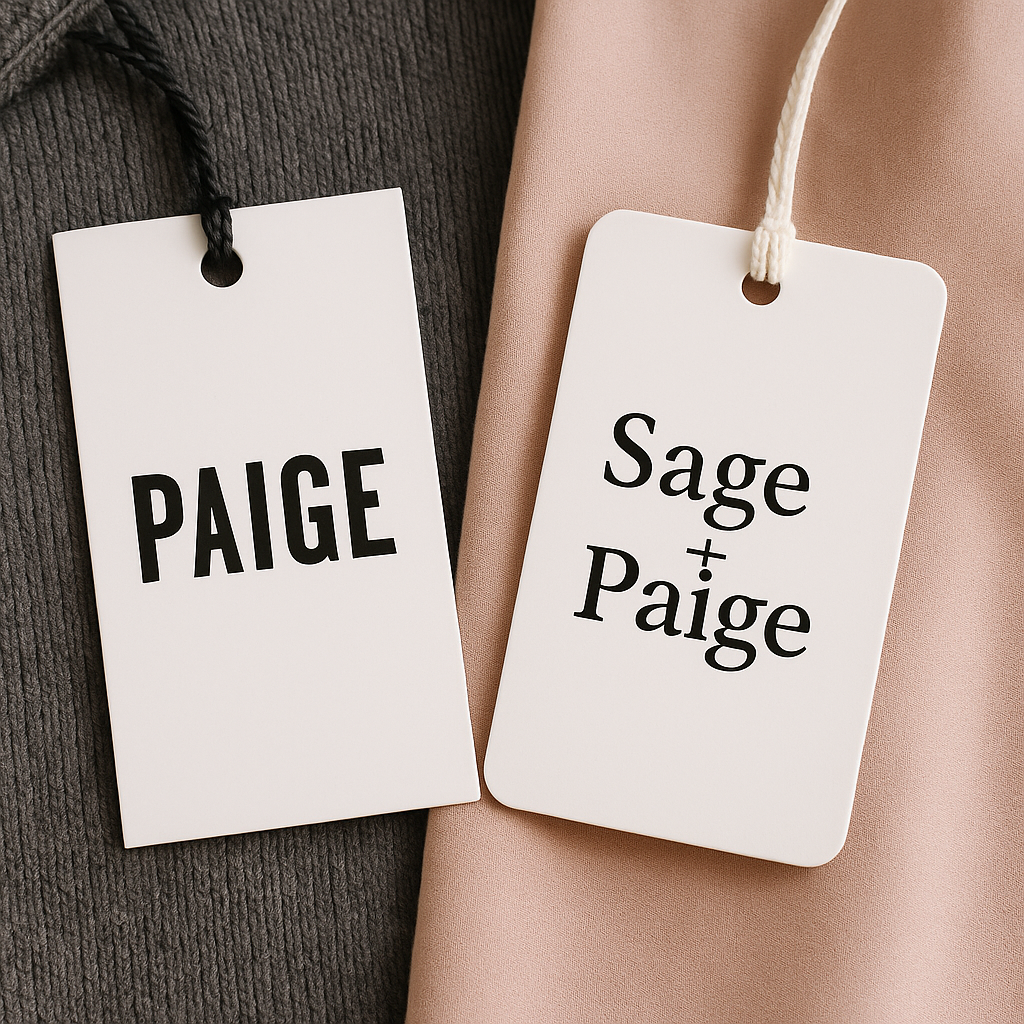
Paige LLC, known globally for its premium denim and celeb collabs, owns the trade mark PAIGE in Australia. When Aussie fashion house Sage and Paige Collective Pty Ltd applied to register two composite trade marks—Saige + Paige (stylised with a pink circle) and Sage + Paige (stylised, but text-only)—the US company objected under:

  • Section 44: deceptive similarity to its PAIGE marks, and

  • Section 60: likelihood of confusion due to its established reputation.

The core argument? That the “+” sign in Sage + Paige might lead consumers to believe it’s a collaboration with PAIGE—a well-known practice in fashion.

⚖️ The Court’s Take

Justice Needham accepted that brand collaborations (or “collabs”) are indeed a recognised trend, and the notional consumer might think of such things. But that wasn’t enough.

“The use of two names with the same stylisation tend to indicate… a singular brand name, rather than two separate, collaborating, brand names.” — Needham J at [89]

Despite PAIGE having a modest reputation in Australia, the Court found no real, tangible danger of deception or confusion. The composite marks were deemed to stand on their own: visually unified, aurally distinct, and conceptually grounded in a “two names, one brand” tradition, not a collab cue.

🧵 Key Takeaways

  • “+” doesn’t equal collab: Just linking two names with a plus sign doesn’t automatically imply co-branding, even in industries where collabs are common.

  • Given names don’t always dominate: Paige is not an invented or highly distinctive term; it’s just a given name, and its presence doesn’t override the overall impression.

  • Stylisation and consumer habits matter: The Court looked at actual branding trends and consumer practices (like buying online and familiarity with fashion collabs).

🪡 The Bottom Line

This is a rich example of the law stitching together traditional principles of deceptive similarity with modern commercial practices. It shows how context—consumer knowledge, industry trends, brand stylisation—can make or break a trade mark opposition, even where name overlap exists.

For now, Sage + Paige gets to strut the IP runway without tripping over PAIGE’s heels.

Filed Under: Fashion Law, IP, Trade Marks Tagged With: Fashion Law, IP, Trade Marks

  • « Go to Previous Page
  • Go to page 1
  • Interim pages omitted …
  • Go to page 6
  • Go to page 7
  • Go to page 8
  • Go to page 9
  • Go to page 10
  • Interim pages omitted …
  • Go to page 19
  • Go to Next Page »

Primary Sidebar

Recent Posts

  • Unf*cking the Register: IP Australia Accepts “UNFVCK YOURSELF” Trade Mark
  • Firework Fizzles (For Now): The High Court Re-stitches the Katy Perry Trade Mark Battle
  • 🏇 When the Race Stops a Nation — Who Owns the Moment?
  • AI Training in Australia: Why a Mandatory Licence Could Be the Practical Middle Ground
  • AI-Generated Works & Australian Copyright — What IP Owners Need to Know

Archives

  • March 2026 (2)
  • November 2025 (1)
  • October 2025 (14)
  • September 2025 (21)
  • August 2025 (18)
  • July 2025 (16)
  • June 2025 (21)
  • May 2025 (12)
  • April 2025 (4)

Footer

© Scott Coulthart 2025